


On April 1, 2026, the United States Patent and Trademark Office (USPTO) announced a procedural addition for ex parte reexamination proceedings to be published in the Official Gazette. Effective for requests filed on or after April 5, 2026, patent owners have a formal mechanism to submit arguments before the Office decides whether to institute a reexamination.
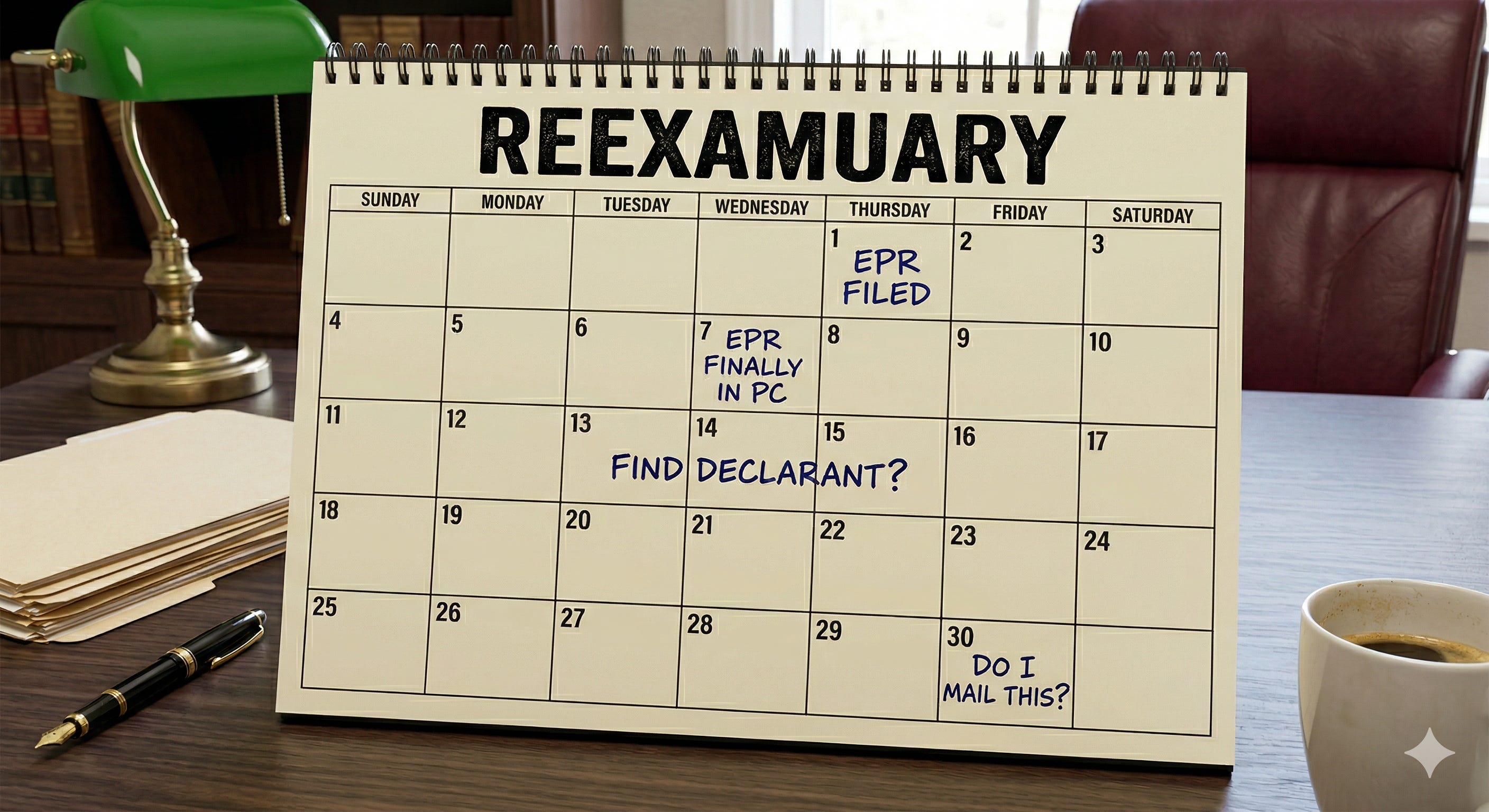
The agency expects the process to “permit the USPTO to efficiently and effectively address the recent increased volume of ex parte reexamination requests by providing examiners with additional information useful for making the SNQ determination” (Announcement, ¶ 2).
The change provides patent examiners with additional context before they determine if a third-party request raises a substantial new question of patentability.
Why Ex Parte Reexamination?
The February 2026 statistics reveal a massive surge in ex parte reexamination filings.
In FY 2025 the Office saw 491 requests, up from 417 in 2024 and 288 in 2023, marking a sharp resurgence and the highest annual volume for these proceedings since 2012.
Even more shocking, in Q1 of FY 2026 (October through December 2025), the USPTO reported 223 new filings, a historic quarterly pace that exceeds the total annual requests received in any single year between 2016 and 2020.
Based on that, it appears that the USPTO may be facing a significant resource logjam as inventory levels swell and average pendency times for these proceedings climb past 21 months.
Consequently, patent practitioners are shifting their approach to view these proceedings as a key strategic pillar rather than a mere fallback, even with the USPTO’s tightening rules on anonymity and estoppel.

New Procedures
Under 35 U.S.C. 303(a), the Director must determine whether a request raises a substantial new question of patentability “within three months following the filing of a request for reexamination” (OG, p. 1). During the initial three-month window, the Office historically lacked a mechanism to receive input from the patent owner. The Office noted that under prior practice, it “has not been able to obtain the benefit of relevant information from patent owner prior to making the substantial new question determination” (OG, p. 1).
Patent owners had to remain silent until after an order granting reexamination to file a statement. The statutory blackout period meant that examiners formulated their initial opinions relying exclusively on the third-party requester’s framing of the prior art and prosecution history. The absence of a formal rebuttal mechanism often allowed requests with questionable assertions to clear the preliminary threshold, forcing patent holders into protracted administrative proceedings.

The new USPTO framework alters the response timeline. Patent owners may submit a paper titled “Patent owner pre-order paper providing information useful in making the SNQ determination” (OG, pp. 1-2). The submission allows the patent owner to argue “why an argued teaching(s) in a proposed SNQ presented in a request for reexamination would not be considered important to a reasonable examiner” (Announcement, ¶ 1). The procedural tool introduces a preliminary adversarial element to a process that historically operated as a one-sided evaluation during its earliest phase.
The standard for finding a substantial new question remains unchanged. As referenced in the notice, the Manual of Patent Examining Procedure specifies that printed publications raise a substantial new question when “(1) the teaching of the patents and printed publications is such that a reasonable examiner would consider the teaching to be important in deciding whether or not the claim is patentable; and (2) the same question of patentability as to the claim has not been decided by the Office in an earlier concluded examination” (OG, p. 1).
According to the Official Gazette, the Federal Circuit previously observed that “the reexamination statute’s purpose is to correct errors made by the government and if need be to remove patents that never should have been granted” (OG, p. 1).
The Office placed strict parameters on the new pre-order submissions. The paper “must be limited to thirty (30) pages or fewer” and must align with the formal requirements of 37 CFR 1.52 (OG, p. 2).
Patent owners must file the response “as soon as possible, but no later than the date that is 30 days from the date of service of the request on the patent owner” (OG, p. 3). The 30-day period cannot be extended under any circumstances.
Substantive Matters
The content of the paper is restricted to arguments and facts demonstrating that the Office should maintain the original decision of patentability. The submission “should not address matters not raised in the request” (OG, p. 2). Practitioners must avoid statutory discretion arguments entirely.
The rules state the paper “specifically should not address why the USPTO should exercise discretion under 35 U.S.C. 325(d), which is taken up after determination of whether there is a substantial new question” (OG, p. 2).
Arguments that an alleged teaching is entirely new should be reserved for a later stage. The Office advised that such challenges “should not be included in a patent owner pre-order paper” considering the short timeframe for a determination (OG, p. 4).
This all points to jumping right into challenging the references within this tight 30-day window.
Patent owners can support their pre-order papers with evidence. Practitioners can file a declaration to support their arguments. A declaration “will not impact the page limit” (OG, p. 2). The Office restricts formatting tactics, stating it “will rely on arguments made in the paper and incorporation by reference will not be permitted” (OG, p. 2).
Other Procedures
Beyond content restrictions, the Office enforces strict service protocols. The patent owner pre-order paper must be served on the third-party requester in accordance with 37 CFR 1.248 (OG, p. 2). This rule limits service methods to electronic mail (provided the parties agree in writing), first-class mail, or direct hand delivery. Practitioners must verify the paper reflects this service. If a submission lacks proper documentation of service, the Office warned that the papers “may be refused consideration” (OG, p. 2).
Third-party requesters face heavy restrictions on replying to the patent owner’s pre-order paper. The Office reasons that the requester “has already filed its request, which has no page limitations” (OG, p. 2). In narrow circumstances, exceptions exist. Requesters may seek permission to file a response “to address alleged misrepresentations of fact or law or other improper arguments that materially impede the determination of a substantial new question” (OG, p. 2).
To utilize the exception, the requester must submit “a responsive paper accompanied by a grantable petition under 37 CFR 1.182 (and fee)” (OG, p. 2). If permitted, the reply is capped at ten pages and must be filed within 15 calendar days from the date of service of the patent owner’s paper (OG, p. 3).
The USPTO streamlined the administrative execution of the process. The Director used authority under 37 CFR 1.183 to automatically waive the provisions of 37 CFR 1.530(a) and the second sentence of 1.540 for timely filed pre-order papers (OG, p. 3).
A separate petition or fee for the waiver is not required. The Office framed the waiver as a response to the “increased volume of ex parte reexamination requests” and the need to gather information efficiently (OG, p. 3).
While the USPTO’s notice page indicates that the paper will be published on April 28th, it appears to go into effect on April 5th. Because this is framed as a waiver of procedural rules (specifically waiving 37 CFR 1.530(a) and part of 1.540 under the Director’s 1.183 authority), the USPTO has the flexibility to implement it for any new proceeding filed on or after that designated April 5 date, even if the formal publication happens weeks later.
Benefits
The implementation of the pre-order paper introduces distinct benefits for patent holders defending their intellectual property. The primary advantage is the opportunity to terminate a reexamination request before it officially begins. An early dismissal saves significant financial resources and limits periods of uncertainty regarding patent validity.
Permitting declarations provides an avenue to introduce expert testimony early in the proceedings. Factual assertions from an industry expert can quickly neutralize an alleged teaching that a reasonable examiner might otherwise find persuasive on a first read. Furthermore, the procedure is highly accessible from an administrative standpoint; the USPTO permits the filing “without filing a petition or paying a fee” and automatically waives the restrictive provisions of 37 CFR 1.530(a) (OG, pp. 1, 3).
The new mechanism empowers patent owners to take an active role rather than remaining bystanders for the first three months of the proceeding. A successful pre-order paper protects the commercial value of the underlying invention by removing the cloud of a pending patentability challenge.
Challenges
The procedure presents substantial procedural and logistical hurdles for patent practitioners. The 30-day deadline demands immediate action. Coordinating with inventors, securing expert witnesses, and analyzing complex prior art requires a highly efficient response upon receiving a request.
For most parties—especially small entities and independent inventors—retaining counsel and drafting a 30-page substantive response accompanied by a declaration within one month demands rapid mobilization of capital and personnel. The unextendable nature of the deadline adds intense pressure to the review process.
Additionally, the rules strictly limit the scope of arguments available. IP professionals must resist the urge to argue that a reference fails to constitute a “new” teaching, as the Office expressly warned that “such arguments should not be included” given the limited timeframe (OG, p. 4).
Similarly, practitioners are barred from raising 35 U.S.C. 325(d) discretionary arguments. Adhering to the strict formal requirements of 37 CFR 1.52 and ensuring proper service on the third-party requester under 37 CFR 1.248 leaves little margin for error in execution.
Risks
Several risks require careful evaluation before a patent owner submits a pre-order paper. Statements made in the submission become part of the permanent prosecution history. Prosecution history estoppel can limit claim scope in future or concurrent litigation. Committing to specific technical arguments or claim constructions early in the process creates rigid positions.
Procedurally, failing to comply strictly with the limitations poses a direct threat to the filing. Papers that do not meet the 30-page limit, formatting requirements, or service protocols “may be refused consideration” entirely (OG, pp. 2, 3).
Even worse, if a patent owner includes what a requester views as improper arguments or misrepresentations, the requester can petition to file a responsive paper (OG, p. 2). This scenario risks granting the challenger an additional opportunity to characterize the art before the examiner.
Finally, if the pre-order paper fails to prevent the institution of the reexamination, the patent owner has provided the third-party requester with a comprehensive preview of the defense strategy. The requester can analyze the expert declarations and arguments, allowing them to adapt their litigation tactics or prepare subsequent challenges with a clearer view of the patent owner’s theories. Practitioners must weigh the probability of successfully preventing institution against the long-term strategic implications of early disclosure. Submitting a pre-order paper is a highly strategic decision requiring a balancing of short-term relief and long-term enforceability.
Practitioner Takeaways
Days 1–5 - Consider Service: Because the submission must be served pursuant to 37 CFR 1.248, practitioners and staff should immediately set a plan for service. For instance, counsel may want to seek written agreement from the requester for electronic mail service to avoid logistical delays and tracking uncertainties of relying on first-class mail or hand delivery.
Days 1–30 - Rapid Resource Allocation: Upon receiving service of an ex parte reexamination request, patent practitioners face an unextendable 30-day window to file a pre-order paper. IP professionals should establish protocols for immediate mobilization of inventors and expert witnesses to meet this strict deadline.
Days 1–30 - Strategic Use of Declarations: During the preparation period, counsel can leverage the procedure to submit expert declarations without impacting the 30-page limit—but patentees cannot incorporate arguments from the declaration by reference. Introducing factual assertions from industry experts early can potentially neutralize prior art arguments before a formal proceeding begins.
15 Days After Patentee Pre-Order Paper - Requester Reply: If a patent owner timely files a pre-order paper, the third-party requester has 15 calendar days from service to seek permission to file a responsive paper via a petition under 37 CFR 1.182. Patentees and counsel must ensure their pre-order submissions strictly comply with the rules to avoid granting the challenger an additional opportunity to characterize the art.
Month 3: Assessing Defensive Previews: The Director will determine whether a substantial new question exists within three months following the request’s filing. If the pre-order paper fails to prevent institution at this phase, the patent owner has supplied the third-party requester with a preview of the defense strategy. IP owners and in-house counsel must assess whether the potential for early termination outweighs the risk of allowing challengers to adapt their litigation tactics.
Long-Term: Prosecution History Estoppel: Regardless of the institution decision, statements made in the pre-order submission enter the permanent prosecution history. Attorneys must carefully weigh the probability of a successful early dismissal against the long-term impact of committing to specific technical arguments or claim constructions that could limit future enforceability.
Conclusion
The introduction of the pre-order paper marks a substantial shift in ex parte reexamination practice. The USPTO’s effort to integrate patent owner feedback earlier in the process reflects a desire for more informed decision-making during the substantial new question determination phase.
By evaluating arguments from both sides before instituting a formal proceeding, the Office aims to allocate examination resources more efficiently. This initiative flows with what Director Squires has been implementing: aiming to maintain the original decision of patentability unless there is a true mistake and reduce the backlog(s).
The biggest acceleration is that patent owners are effectively defending the validity of their claims over the cited art before the Office has even formally decided to reexamine them. The new rules effectively defer patentee arguments about the “discretion” and “newness” of the references.
Patent practitioners have to hustle to examine the art and work with an expert declarant—counsel must adjust their internal intake procedures to accommodate the strict 30-day filing window. The clock starts at service, but there will surely be questions about delay due to mail and/or Patent Center not running smoothly.
Patent owners face a new tactical decision when confronted with an ex parte reexamination request, requiring swift evaluation of the merits and risks of early engagement.
The process creates a formalized channel for early advocacy, reshaping the initial stages of post-grant patent challenges. Due to the tight timeframe, it won’t be without its initial hiccups.
Disclaimer: This is provided for informational purposes only and does not constitute legal or financial advice. To the extent there are any opinions in this article, they are the author’s alone and do not represent the beliefs of his firm or clients. The strategies expressed are purely speculation based on publicly available information. The information expressed is subject to change at any time and should be checked for completeness, accuracy and current applicability. For advice, consult a suitably licensed attorney and/or patent professional.