


For nearly a decade, the inter partes review (IPR) has dominated the post-grant validity conversation. Patent owners and challengers alike have focused their attention—and their budgets—on the Patent Trial and Appeal Board (PTAB). However, statistics released a couple weeks ago (February 2026) by the United States Patent and Trademark Office (USPTO) indicate a dramatic, perhaps even shocking, pivot in strategy. A recent USPTO Hour webinar discussed the role of the Central Reexamination Unit (CRU).
The latest data reveals that ex parte reexamination, a legacy proceeding often viewed as a secondary option, is experiencing an unprecedented resurgence.
The numbers for the first quarter of fiscal year 2026 (from October 1, 2025 through December 31, 2025) suggest that the intellectual property community is witnessing a historic migration away from the PTAB and back to the Central Reexamination Unit (CRU).
For patent practitioners and in-house counsel, ignoring this trend could result in significant strategic blind spots.
The Shocking Surge in Filings
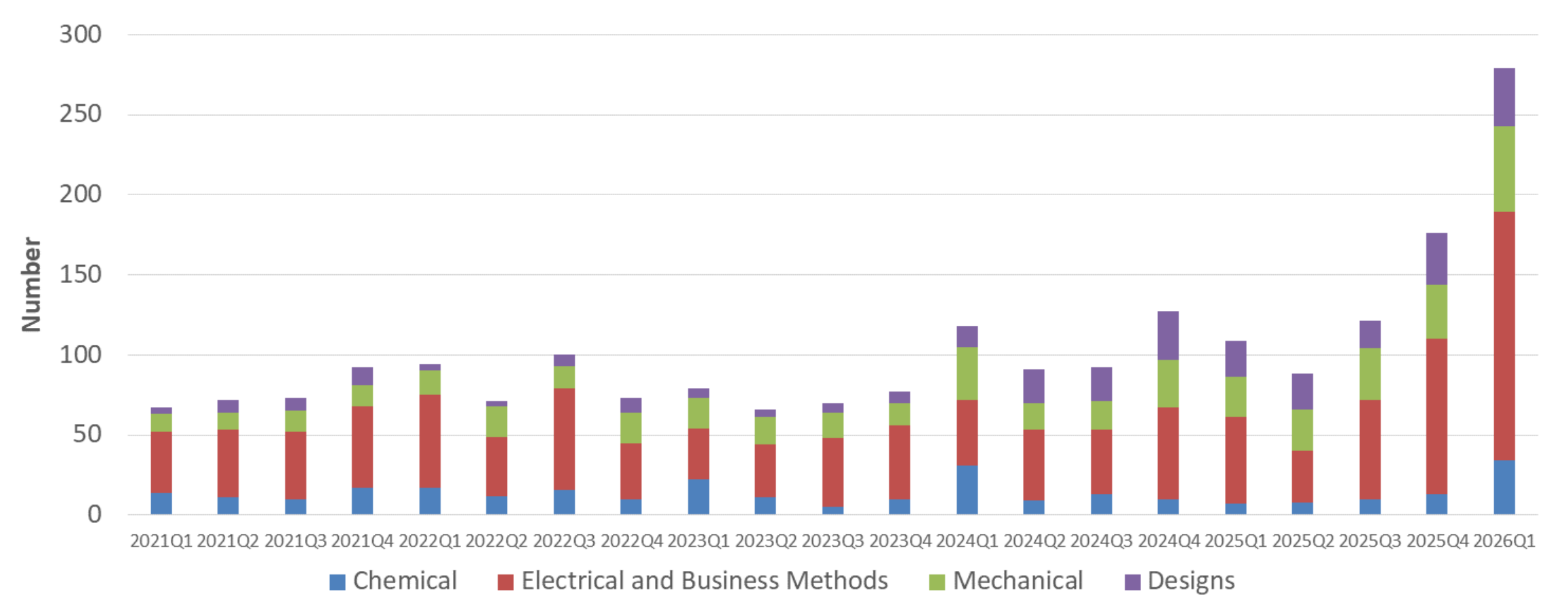
The most alarming data point in the USPTO’s recent release concerns the sheer volume of new filings. For context, filing rates for ex parte reexamination hovered between 163 and 300 annually from 2015 through 2021 (Historical Stats, p. 1). The process was steady but quiet.

That quiet has ended. In fiscal year 2025, the Office received 491 requests, a substantial increase from the 417 filed in 2024 and the 288 filed in 2023 (Historical Stats, p. 1).
While a yearly total of 491 is notable—representing the highest annual figure since 2012—it is the quarterly data from the start of FY 2026 that signals a true potential sea change.
In just the first quarter of FY 2026 (October through December 2025), the USPTO reported 223 new ex parte reexamination filings (Operational Stats, p. 1).
To put this into perspective, the Office received more requests in these three months than it did in the entirety of fiscal year 2016, 2017, 2018, 2019, or 2020 (Historical Stats, p. 1).
If this quarterly run rate continues, FY 2026 could see nearly 900 filings.
Such a volume would eclipse the previous historical record of 780 filings set in 2012 (Historical Stats, p. 1), effectively resetting the baseline for administrative patent challenges.
The Litigation Connection
Perhaps the most telling statistic—and one easily overlooked in the aggregate data—is the relationship between these new filings and concurrent litigation.
Historically, the percentage of ex parte reexaminations “known to be in litigation” hovered in the low-to-mid 30s. However, the cumulative rate has climbed steadily in recent years, reaching an all-time high of 40.5% in FY 2025 (Historical Stats, p. 1).
While 40.5% might seem modest, the trend reveals the true story. Because this is a cumulative statistic spanning back to 1981, it is difficult to move the needle. For the cumulative average to jump from 39.2% in 2024 to 40.5% in 2025, the new filings must be overwhelmingly litigation-heavy.
A closer look at the delta between years confirms this. While the USPTO added approximately 481 new requests to its cumulative count in FY 2025, the number of cases “known to be in litigation” jumped by 396 (Historical Stats, comparison of FY 2024 and FY 2025 reports). This indicates that over 80% of the net new activity in FY 2025 was linked to litigation.
This data strongly corresponds to the general suspicions that the current surge is not driven by patent owners tidying up their portfolios or random third-party quality checks. Instead, ex parte reexamination has been fully weaponized as a litigation tactic, likely serving as a lower-cost alternative to IPR or a secondary line of attack.
Electrical Patents are the Engine of Growth
While the Q1 2026 operational statistics report does not break down filings by technology center or discipline, the fiscal year data from 2025 offers a clear picture of what is being challenged. The surge is not evenly distributed; it is being driven primarily by “Electrical Operation” patents—a category that typically includes software, telecommunications, and computer architecture.
By comparing the cumulative historical data from the end of FY 2024 to the end of FY 2025, we can isolate the filings for that specific year. The results are stark:
Electrical Operation: +242 filings
Mechanical Operation: +80 filings
Chemical Operation: +69 filings
Design Patents: +90 filings
Of the calculated 481 new filings added to the cumulative count in FY 2025, Electrical Operation patents accounted for roughly 50%.
This aligns with the litigation data, as high-tech and software patents are frequent targets in litigation campaigns.
Drivers Behind the Shift
Why the sudden aggressive move toward ex parte reexamination? Several factors likely contribute to this phenomenon, and IP professionals should weigh them carefully.
It is important to remember that the primary differentiator in these administrative procedures is that while IPR is an adversarial trial, ex parte reexamination returns the patent to a traditional examination state where the challenger has no participation rights after the initial filing.
Accordingly, cost efficiency remains a driver—an IPR can cost upwards of several hundred thousand dollars through trial. In contrast, ex parte reexamination fees are significantly lower, and the proceeding does not involve the heavy discovery and oral advocacy expenses associated with trial-like PTAB proceedings. In an economic environment where legal budgets are often scrutinized, the CRU offers a compelling value proposition.

Second, the specter of estoppel in IPR proceedings cannot be overstated. A final written decision in an IPR creates broad estoppel, preventing a petitioner from raising arguments in district court that they raised or reasonably could have raised during the IPR. Ex parte reexamination generally carries no such estoppel for third parties. This allows a challenger to take a “free shot” at the patent without necessarily compromising their district court defenses, although the strategy is not without limits; recent case law like In re Vivint has placed guardrails on abusive serial IPR filings.
Finally, anonymity plays a crucial role. Unlike IPR petitions, which require the identification of real parties in interest, an ex parte reexamination request can be filed by a straw man. This allows competitors to challenge patents without immediately revealing their identity.
However, the USPTO’s February 2026 EPR Guidance will add a procedural check: if the patent was subject to a prior IPR final written decision, anonymous requesters must now affirmatively state they are not the prior petitioner (or a privy) to avoid estoppel. While anonymity remains a powerful tool, this new requirement forces challengers to carefully vet their filings to avoid vacatur (or attorney sanctions).
Outcomes: A Double-Edged Sword
While the filing numbers suggest challengers are enthusiastic, the outcome statistics offer a more sober reality. Reexamination is not necessarily a patent killer.
According to the historical data through September 30, 2025, only 16.1% of certificates issued from third-party requests resulted in all claims being canceled (Historical Stats, p. 2). This is a slight decrease from the previous year’s rate of 16.9% (Historical Stats, p. 4), suggesting that complete invalidation is becoming marginally more difficult.
However, the risk to patent owners remains substantial. The data shows that in 61.0% of third-party requested reexaminations, claims are changed (Historical Stats, p. 2). This means that while the patent survives, it often emerges with narrower claims.
For a patent owner, this survival comes at a cost: the scope of protection is reduced, potentially allowing competitors to design around the amended claims. For the challenger, a “changed” claim is a partial victory, but it does not remove the patent from the board entirely.
It is also worth noting the high grant rate. In FY 2025, examiners denied only 129 requests while granting 1,294 (Historical Stats, p. 1). With a grant rate hovering near 91-92%, filing a request almost guarantees that the patent will be dragged into examination, creating cloud on title and uncertainty for the patent owner.
Pendency Times are Climbing
Unlike the rigid 12-month statutory deadline of an IPR, reexamination proceeds on a more open-ended timeline—statutorily required to be handled with “special dispatch”—which allows for iterative prosecution, examiner interviews, and claim amendments.
The surge in filings appears to be straining the system, and the data points to a developing logjam. For years, the average pendency from filing to the issuance of a certificate hovered around 18 months. However, the influx of new cases is beginning to drag out timelines and swell the inventory of pending cases.
For the quarter ending December 31, 2025, the average time from filing to the issuance of a reexamination certificate reached 21.24 months for ex parte proceedings (Op Stats, p. 2). Compare this to the fourth quarter of FY 2025, where the average was 18.05 months (Op Stats, p. 4). A jump of more than three months in average pendency over a single quarter indicates that the CRU is facing a backlog.
Even more concerning is the explosion in pending inventory. Between the end of FY 2025 and the first quarter of FY 2026, the total number of pending reexaminations jumped from 679 to 886—an increase of nearly 30% in just three months (Op Stats, pp. 1, 3).
This growth is driven by a massive disparity between intake and output. In Q1 FY 2026, the Office received 236 new filings but issued only 90 certificates (Op Stats, p. 1). This surplus of 146 cases suggests the backlog will continue to compound.
The strain is already visible at the “front door” of the CRU: the number of cases merely “Awaiting Order/Denial” nearly doubled from 96 in the previous quarter to 163 (Op Stats, pp. 1, 3).

Strategic Implications
The data suggests that IP strategies must adapt.
For Patent Owners:
Expect Challenges: The “quiet” years are over. Portfolios that were previously considered safe from administrative challenge because they were not high-value enough for an IPR are now vulnerable to the cheaper reexamination process.
Litigation Equals Reexamination: With over 80% of recent growth linked to litigation, patent owners must assume that asserting a patent—especially in high-tech fields—will trigger a reexamination request.
Electrical Portfolios at Risk: The surge is disproportionately affecting electrical and software patents. Owners in this sector should conduct preemptive validity stress tests before filing suit.
Prosecution Hygiene: With reexamination becoming common, ensuring that the original prosecution file is clean and robust is vital.
For Challengers:
Navigate the New Gatekeeping: The February 2026 guidance forces anonymous requesters to verify they aren’t circumventing IPR estoppel. While anonymity is preserved, the administrative burden to vet real parties in interest is higher.
Manage Expectations: While getting a request granted is highly likely, a “total kill” of the patent is statistically rare (16.1%). The most likely outcome is a narrowed patent.
Timing is Key: With pendency times slipping past 21 months, reexamination is not a quick fix. If litigation is imminent or ongoing, a stay may be difficult to secure if the court believes the reexamination will drag on indefinitely.
Conclusion
The USPTO’s latest statistics serve as a wake-up call. Challenges at the USPTO are adjusting. The explosive growth in ex parte reexamination filings in early FY 2026—driven overwhelmingly by litigation-related challenges and electrical technology—indicates that the market has fundamentally re-evaluated the utility of this proceeding.
It is no longer a relic of the pre-AIA era but a central pillar of modern patent strategy, offering a lower-cost, anonymous alternative to IPR.
However, this resurgence is not without its hurdles; the new February 2026 guidance introduces critical gatekeeping for anonymous requesters with prior IPR history, raising the stakes for serial challenges.
As filings rise and pendency times lengthen, practitioners must view reexamination not as a fallback, but as a primary option with distinct advantages and distinct risks.
Disclaimer: This is provided for informational purposes only and does not constitute legal or financial advice. To the extent there are any opinions in this article, they are the author’s alone and do not represent the beliefs of his firm or clients. The strategies expressed are purely speculation based on publicly available information. The information expressed is subject to change at any time and should be checked for completeness, accuracy and current applicability. For advice, consult a suitably licensed attorney and/or patent professional.