


The United States Patent and Trademark Office (USPTO) is systematically integrating artificial intelligence into its daily operations. Agency leadership frequently characterizes this strategy as “augmented intelligence,” focusing on supplementing expert human reviewers rather than replacing them.
Weeks ago, the USPTO published a video detailing a major new integration: the Application Summary Tool, embedded directly into the Document Review System (PE2E-DAV) and driven by the USPTO Scout LLM (Searching, Consolidating, Outlining, and Understanding Tool). Summarizing huge specifications is a low-hanging use case, but this tool implements eight summary sections from the abstract, specification, and latest claims.

A prior video showed how SCOUT’s multi-model architecture allows personnel to select from engines like Google’s Gemini, Anthropic’s Claude, Meta’s Llama, and OpenAI’s GPT (preventing vendor lock-in). Here, it remains unclear exactly which flavor of LLM powers this specific summarizer or what underlying prompts are used.
Early initiatives established a solid foundation for data integrity and prior art searching, deploying tools like automated “Similarity Search” to sift through over 120 million documents. Now, SCOUT can focus on a single specification.
By reviewing the mechanics of the Application Summary Tool, patent professionals can start anticipating exactly how machine-generated summaries might reshape patent prosecution.
Access and Processing Applications
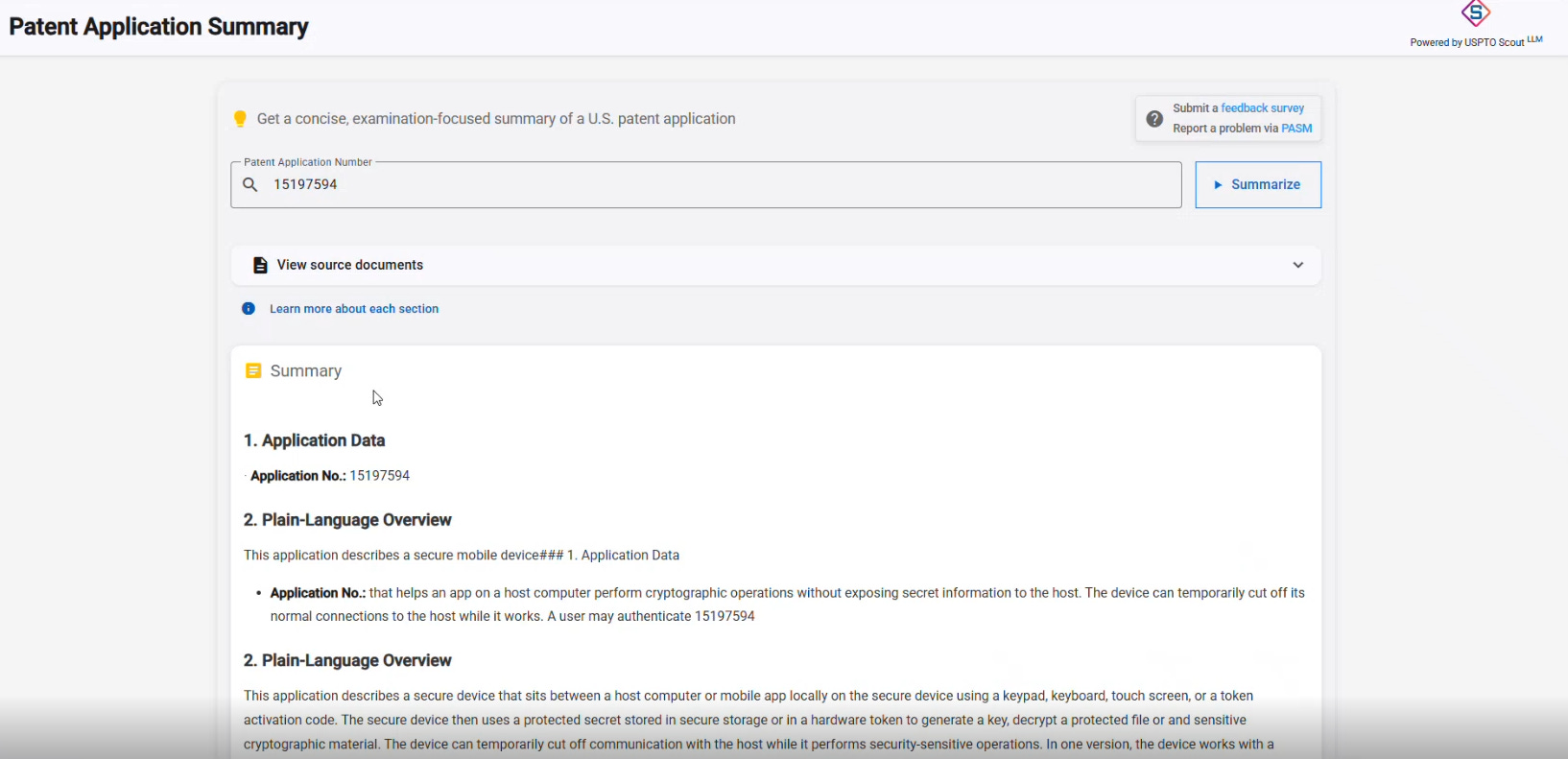
Based on the video, examiners access the Application Summary Tool directly within the application viewer. Applications can be accessed via direct number input or by clicking from a list of (12) recently viewed applications. Once “in” the desired application, clicking a button designated for “AI Report Tools” and then clicking “Application Summary” activates the summarization process (00:02:28).
The system automatically pulls three specific USPTO source documents to build the summary. Specifically, the tool processes the earliest filed specification and abstract, combined with the latest filed claims (00:03:44). There must be application metadata that is incorporated, e.g., via Patent Center. It is unclear if/how figures are handled outside of their respective text descriptions.
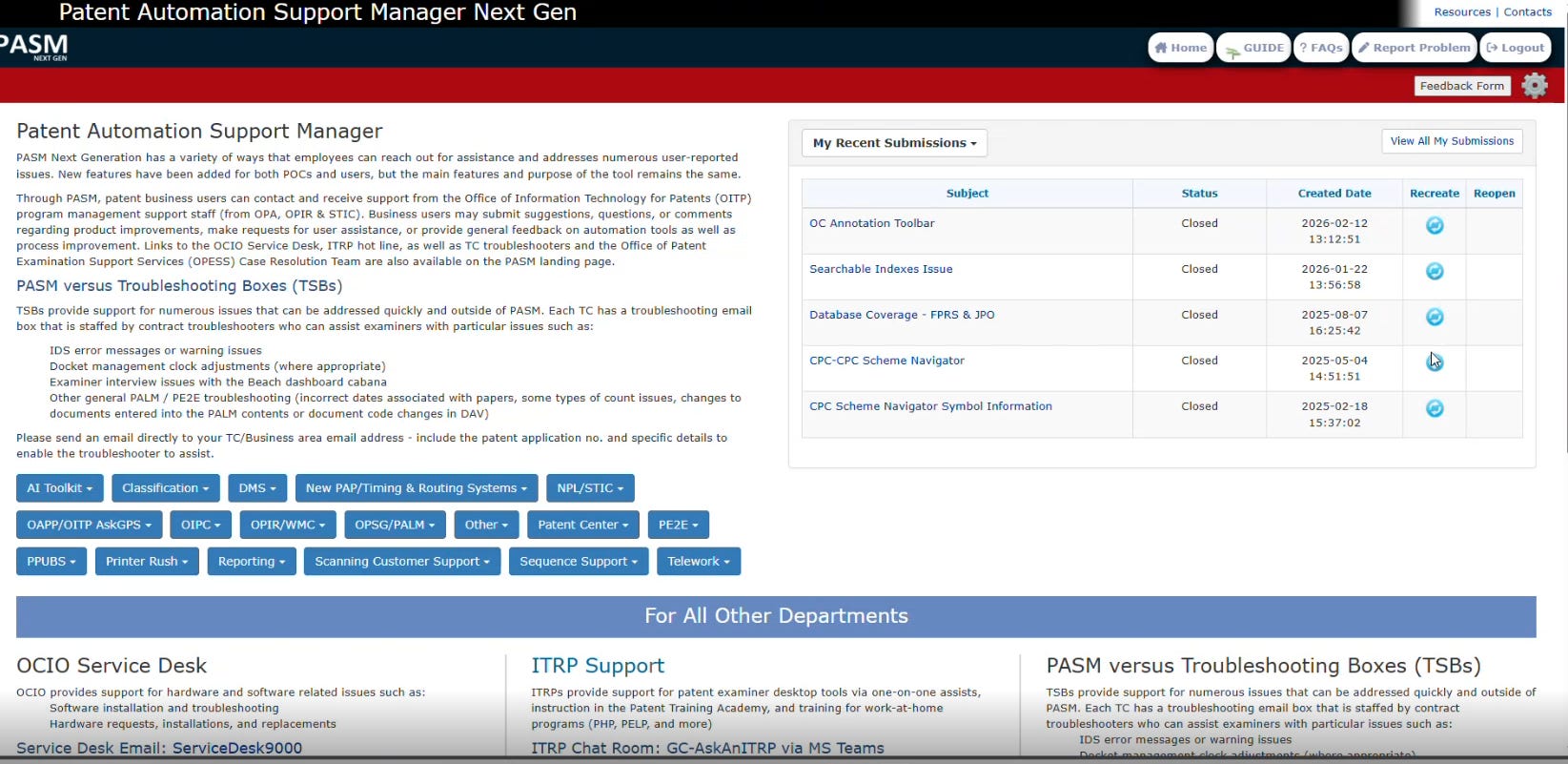
The summary has eight section (detailed below) and is output as webpage available for printing or download. There are two feedback tools—e.g., a survey and an error reporting portal—but it is unclear if each is a pre-production request or an ongoing issue pathway. It appears that PASM (Patent Automation Support Manager) is the department handling bugs and feature suggestions here.
One noticeable omission from the agency’s training video is the status of yet-to-be-published applications. The video provides no discussion regarding whether the system can summarize unpublished cases. Previous public releases detailing SCOUT’s general conditions of use prohibited users from uploading unpublished applications to prevent data leaks.
The video (mirrored below) stated that unpublished applications and file wrappers “must not be used within or uploaded to Scout LLM.” Whether the embedded DAV tool bypasses this limitation for internal use remains unaddressed in the available presentation.
The Eight Sections of the Application Summary
Once processing completes, the platform generates an eight-part summary report. The sections attempt to categorize the highly technical content of the application.
Application Data: Lists identifying information about the patent application, including the specific application number and the designated title of the invention (00:04:54). It provides context for the summary and links to the official record.
Plain-Language Overview: Explains the invention’s purpose and function in everyday language. The goal is to outline what the invention does and how it works in about 10 sentences, making the technical subject matter “accessible to non-experts” (00:05:17).
Problem Addressed: Describes the specific challenge or issue the invention claims to solve. It clarifies why the invention is needed and identifies what gap it fills in current technology or practice (00:05:32).
Applicant’s Solution: Details the main inventive concept and how it resolves the stated problem (00:05:42). The system generates a table linking core concepts to their specific location in the specification, explaining why each is central to the invention.
Key Technical Features: Catalogs the most important technical elements or steps that make the invention work (00:06:00). A corresponding table maps each feature to its location in the specification and its significance.
High-Level Search Strategy: Suggests main areas and related fields for prior art searching. It includes primary search domains and other potential search areas paired with brief rationales (00:06:22).
Numeral-to-Feature Mapping: Maps reference numerals from the figures to their corresponding features and figure numbers, helping examiners quickly identify components in the drawings (00:06:34).
Representative Claims & Drawings: Indicates which claims and figures best illustrate the applicant’s solution and its novelty. It notes if prior art is shown and highlights the claims and figures that capture the inventive aspects (00:06:50).
Benefits and Risks of Summarization
An artificial intelligence overview offers examiners a method to rapidly process voluminous patent applications. Sections 3 and 4 (Problem and Solution) directly parallel inquiries under 35 U.S.C. § 101. An explicit mapping of features back to the specification (Sections 5 and 7) could streamline § 112 inquiries or might effectively ground the Broadest Reasonable Interpretation (BRI) standard.
Still, relying on machine-generated interpretations presents specific risks that practitioners should carefully weigh. Large language models can mischaracterize core inventive concepts. Certain sections of the summary report, such as Section 3 (Problem Addressed) and Section 4 (Applicant’s Solution) attempt to compress complex technical framing and can create new dangers for the prosecution process.
For instance, if an examiner anchors an initial impression on a flawed artificial intelligence summary, the resulting Office Action might misapply prior art or misinterpret the scope of the claims. The reduction of a complex patent application into a 10-sentence overview risks losing the precise boundaries of the intellectual property being claimed.
Section 6 (High-Level Search Strategy) introduces another layer of risk regarding prior art. Directing an examiner’s prior art search based on a language model’s interpretation relies heavily on the machine’s internal associations. If the generative artificial intelligence creates an overly narrow search strategy, the examiner might fail to locate the most relevant prior art. An overly broad search strategy might lead the examiner down a path of irrelevant citations, producing rejections based on non-analogous art.
Section 8 (Representative Claims & Drawings) is concerning from a legal perspective. The system indicates which claims and figures capture the inventive aspects. Determining novelty requires a substantive legal conclusion. Assigning this task to a language model introduces a potential point of failure. If the artificial intelligence overlooks a nuanced dependent claim or misidentifies the true point of novelty, the examiner might ignore the other claims.
The risk of confirmation bias is high; an examiner might rely on the machine’s selection rather than conducting an independent evaluation of the entire claim set.
The Public Record Exception
The training dictates that the “application summary report is not to be uploaded as part of the official record” (00:07:28). This lack of transparency presents a significant challenge for patent applicants and their representatives. The summary is available for download to the examiner’s local system, giving them the ability to print or save the document. It will never appear in the prosecution history.
Applicants and their counsel will remain unaware if an examiner’s rejection, allowance, or overall perspective was influenced by a flawed Scout LLM summary. The report remains completely invisible to the public. This opacity complicates an applicant’s ability to correct the record.
When an Office Action contains a fundamental misinterpretation of the invention, the applicant will have no way of knowing if that misinterpretation originated from the examiner’s independent reading or from an erroneous artificial intelligence summary. The inability to inspect the tools used against the application creates an asymmetry of information between the patent office and the applicant.
Takeaways for Practitioners
The integration of the USPTO Scout LLM into the examination process represents a shift in how applications are reviewed. The efficiencies gained by the Office must be balanced against the risks of machine-generated errors and the lack of transparency in the official record.
Practitioners will need to adapt their drafting and prosecution strategies to account for the presence of this hidden tool. Applicants (and the public) will not get to see these summaries and there is no reliable, consistent way to replicate or otherwise prepare for the condensed output.
Takeaways:
Explicit Drafting: Practitioners should prioritize explicit, unambiguous problem-solution statements within the specification. Clear demarcation of the invention’s purpose will help guide the artificial intelligence in generating a more accurate summary.
Importance of the Abstract: The Abstract may rise in priority with this new tool explicitly pulling the 150-word description along with the specification and claims. While prior abstracts might reiterate generalities, new abstracts might be an opportunity to direct the LLM and examiner towards the right embodiment, problem/solution, or innovative features.
Consistent Terminology: Using strict consistency between the claims and the specification will aid the system’s mapping features. Variations in terminology could confuse the model and lead to inaccurate mapping in Sections 4 and 5.
Highlight Alternative Embodiments: Because the AI summary may ignore secondary inventions, explicitly detail the importance of alternative embodiments in the background or summary sections of your drafts to increase the likelihood the LLM captures them.
Strategic Interviews: When responding to rejections that appear to inexplicably mischaracterize the invention, practitioners should recognize that an artificial intelligence summary might be the source of the examiner’s misdirection. Conducting an examiner interview to verbally clarify the invention’s core concepts and correct initial misconceptions can mitigate this risk.
Conclusion
Taking a step back, this specific integration is exactly how most stakeholders believed the USPTO would implement a large language model. While the opacity of the public record exception is a valid concern, the day-to-day practical risks may not be a radical departure from current realities. Ultimately, the dangers of a flawed AI summary are not much greater than those already present if, for example, an overwhelmed examiner were to skip crucial paragraphs or rely entirely on “Ctrl-F” to parse an application.
Moreover, the inherent behavioral quirks of large language models might introduce an unexpected advantage. Depending on the underlying prompts, LLMs tend to be positive, agree with the input, and helpfully fill in the gaps. If an examiner queries the system with a question like, “Is XYZ covered in this text?,” a model’s natural inclination is likely to affirm the premise. It tends to result in several passages being identified and cobbled together to affirm that the requested text is indeed found within the specification.
While such sycophancy might be a problem in other analytical contexts, it meets a formidable counterforce here. Traditional examiner skepticism, trained to rigorously challenge claims, is likely a proper balance to the LLM’s eager positivity. Together, they may create a surprisingly functional equilibrium—that could save time and resources for the agency and applicants.
Still, the integration of the USPTO Scout LLM represents a significant shift in how applications are reviewed. Practitioners will have to adapt their drafting and prosecution strategies to account for the presence of this quasi-hidden tool.
Disclaimer: This is provided for informational purposes only and does not constitute legal or financial advice. To the extent there are any opinions in this article, they are the author’s alone and do not represent the beliefs of his firm or clients. The strategies expressed are purely speculation based on publicly available information. The information expressed is subject to change at any time and should be checked for completeness, accuracy and current applicability. For advice, consult a suitably licensed attorney and/or patent professional.