


On February 18, 2026, the United States Patent and Trademark Office (USPTO) held a ‘USPTO Hour’ webinar regarding the Central Reexamination Unit (CRU). The session, featuring Deputy Commissioner for Patents Charles Kim, Acting Director of the CRU Fenn Mathew, and Management Quality Assurance Specialist Stephen Stein, provided a status update on the unit’s workload and procedural adjustments.
The data presented paints a clear picture: the CRU is facing a sharp increase in demand, particularly within the electrical engineering sector.
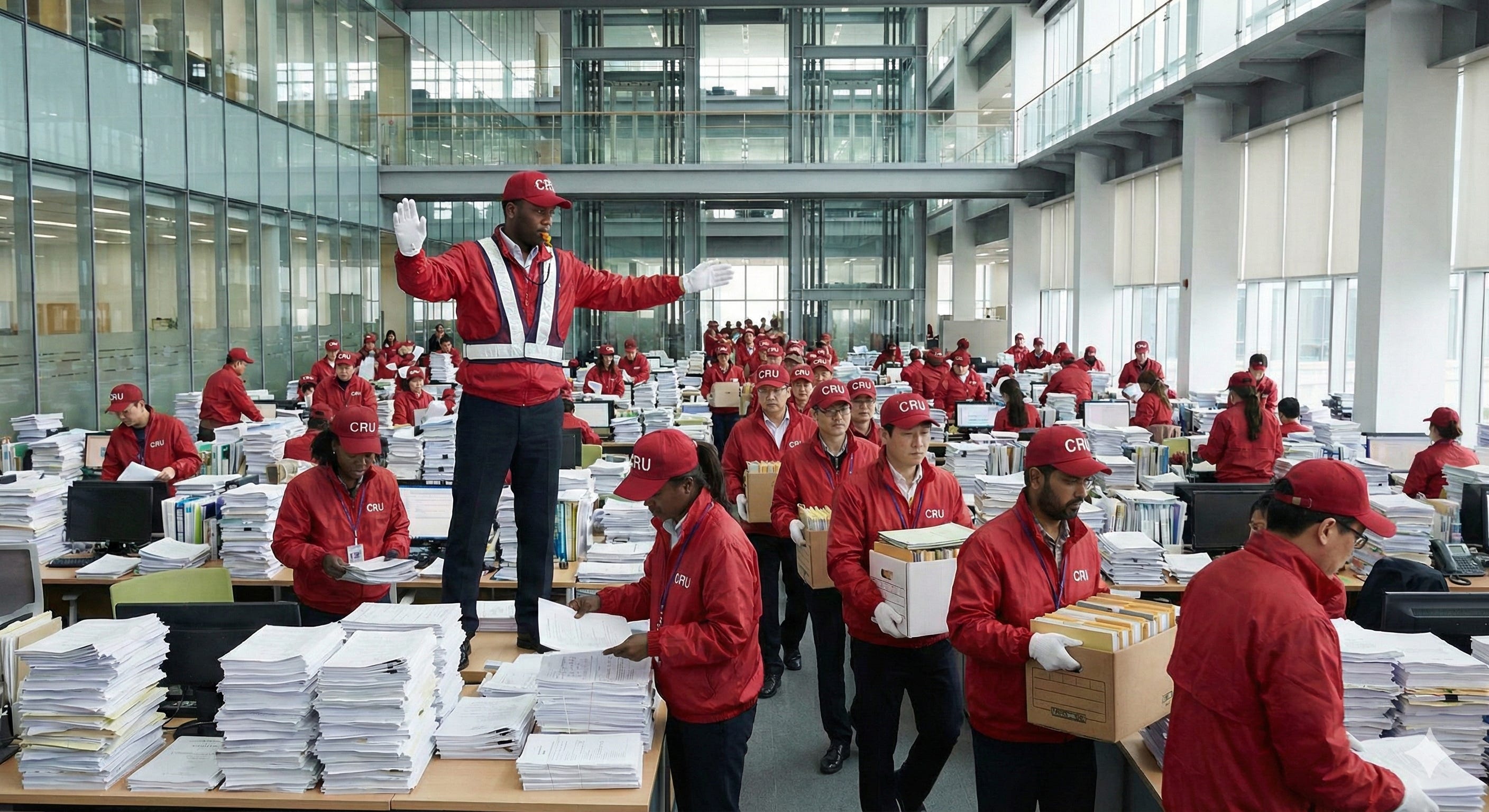
In response, the Office is implementing pilot programs designed to increase throughput, though these efficiency measures bring procedural nuances that practitioners must watch closely.
The “Significant Uptick” in Filings
The headline statistic from the presentation is the volume of incoming work. Fenn Mathew, Acting Director of the CRU, presented data covering the last five fiscal years. While there has been a steady increase generally, the recent quarters show a distinct spike.
“[Last] quarter in the past year, these reexamination filings have seen a significant uptick,” Mathew noted. While increases were observed across chemical, mechanical, and design disciplines, the primary driver is specific. “Most recently we’ve seen the most significant increase within the electrical disciplines,” Mathew stated.
Despite this volume, the CRU reports it is meeting its statutory deadlines. Under 35 U.S.C. § 303, the office must determine whether a request raises a substantial new question of patentability (SNQ) within three months.
Mathew highlighted that “the line the lower line, the central reexamination unit or CRU has been doing a fantastic job in terms of timeliness. Despite the increase in filings, the CRU has been able to maintain... [timeliness].”
The data indicates the CRU may be averaging under the three-month statutory limit for SNQ determinations recently.
Operational Pilots: Efficiency vs. Scrutiny?
To manage this workload without ballooning pendency, the USPTO has initiated two pilot programs that alter how examiners handle these cases.
Reexamination Conferencing Panel Pilot: Historically, CRU panels consisted of three members. The new pilot reduces this to two members: the specialist in charge and one supervisory patent reexamination specialist. Mathew explained the rationale: “The modification is expected to allow CRU examiners to focus on assigned reexamination proceedings in lieu of participating in review conferences; thereby creating greater examination capacity.”
Production Pilot: The office has introduced a production credit system for reexamination specialists, modeled after the utility corps system. The results, according to Mathew, are statistically positive: “During the pilot period, CRU issued twenty three percent more first actions on the merits and orders in the same time period proceeding the pilot. And this occurred despite a 32 percent reduction in staff.”
Best Practices and Procedural Pitfalls
Stephen Stein provided technical guidance for practitioners, focusing on errors that frequently lead to non-compliant filings.
Streamlined Reexamination Requests
Practitioners seeking the fee reduction for streamlined requests must adhere strictly to the 40-page limit. Stein clarified a common misconception regarding claim charts and declarations. “Claim charts, even if separately presented from the arguments in the request, are included in the page count,” Stein warned. Furthermore, “any third party declarations which contain arguments as to patentability are deemed to be included in that forty-page count.”
Service Requirements
Service remain a strict procedural hurdle. Stein emphasized that for third-party requests, service by transmission is heavily restricted. “Right now under 37 C.F.R. 1.248 which governs service the types of service by transmission is limited to first class mail.”
Stein reiterated that for third-party requests, service by transmission is restricted, noting that “email, facsimile, and other manners of service” are generally not permitted without the prior agreement of the parties under Rule 1.248.
Failure to properly serve the patent owner precludes the awarding of a filing date.
Reissue Applications
For reissue applications, particularly those seeking to broaden claims, specific identification of errors is required. Stein noted that “merely generically pointing to a statement that indicates the claim being broadened is not sufficient.”
Applicants must identify the specific word or phrase being broadened and explain how it renders the patent partly inoperative.
Upcoming Policy: Anonymous Filings and Estoppel
On February 6, 2026, the USPTO released an alert regarding a new Official Gazette notice (scheduled for publication March 3, 2026) that clarifies the requirements for anonymous ex parte reexamination requests. This guidance specifically targets patents that have previously been subject to Inter Partes Review (IPR) or Post Grant Review (PGR).
Under 35 U.S.C. §§ 315(e)(1) and 325(e)(1), a petitioner in an IPR or PGR that results in a final written decision is estopped from requesting a proceeding before the USPTO with respect to that claim on any ground the petitioner raised or reasonably could have raised.
Historically, a real party in interest has been able to file a reexamination request anonymously by utilizing the services of a registered practitioner. In these instances, the practitioner certifies that the estoppel provisions do not prohibit the filing. However, the Office has identified a verification gap, noting it has “no procedure or means to confirm the accuracy of such certification when the request is filed anonymously.”
The new guidance preserves the requester’s anonymity—even to the USPTO—but tightens the certification process.
If at least one claim of the patent for which reexamination is requested was previously challenged in an IPR or PGR that resulted in a final written decision, the anonymous request must now include an affirmative statement confirming the requester is not the estopped party.
To avoid having the filing date vacated under 37 CFR § 1.510(d), the request must contain three specific disclosures:
Non-Estoppel Certification: An explicit statement that the real party in interest (including the requester and any privies) is not the petitioner of the prior IPR/PGR, nor a real party in interest or privy to that petitioner.
Identification of Proceedings: A list of the prior IPR or PGR proceedings (e.g., IPR202x-xxxxx).
Identification of Prior Parties: The name of the petitioner and any real parties in interest listed in the records of those proceedings (referencing 35 U.S.C. §§ 312(a)(2) or 322(a)(2)).
Practitioners must note that this is not merely a formality. The guidance explicitly warns that “failure to provide the affirmative statement... may result in the filing date being vacated.” The Office views this statement as a prerequisite to satisfying 37 CFR § 1.510(b)(6).
This policy shifts a heavier burden onto patent attorneys. By signing a request containing this affirmative statement, a practitioner is making a factual representation under 37 C.F.R. § 11.18 regarding their client’s relationship to prior litigants.
Practitioners should likely consider obtaining a written warranty or indemnification from their anonymous clients confirming they are not privies to the prior IPR petitioners before submitting such a certification to the Office.
Benefits, Challenges, and Risks
The CRU’s ability to process SNQ determinations in under two months, despite a surge in electrical filings, suggests a robust operational framework. The shift to two-member panels and production credits has objectively increased throughput (23% more first actions).
For third-party requesters, this suggests that ex parte reexamination remains a viable, time-efficient alternative to PTAB litigation for challenging validity based on patents and printed publications.
However, the strict adherence to procedural rules remains a barrier. Stein’s comments regarding the inclusion of declaration arguments in page counts for streamlined requests indicate that the office is taking a hard line on formatting. Practitioners accustomed to “stuffing” declarations with legal arguments to save space in the brief will find their requests rejected or charged the higher fee.
Additionally, the upcoming requirement for anonymous filers to affirmatively state they are not estopped adds a layer of liability for practitioners signing those papers.
There is a potential quality risk associated with the new pilot programs. Reducing a review panel from three members to two removes one layer of scrutiny.
When combined with a new “production credit” system that incentivizes speed (issuing more actions), there is a foreseeable risk that the thoroughness of examination could suffer.
While the CRU was established to centralize expertise and improve quality, incentivizing volume and reducing panel oversight usually creates a tension with quality assurance.
Patent owners should scrutinize reexamination orders and office actions closely for signs that the examiner may have overlooked nuances in the art due to these new production pressures.
Conclusion
The CRU is clearly adapting to a heavier workload dominated by the electrical sector, but the operational shifts required to meet this demand signal a fundamental change in the unit’s character. While the reported timeliness statistics are commendable—averaging SNQ determinations in under two months—the procedural mechanisms achieving that speed warrant cautious observation by the patent bar.
By introducing production credits and reducing panel size from three members to two, the USPTO is effectively shifting the CRU closer to the production-driven model of the general examining corps. This move risks diluting the very “specialist” nature that was the CRU’s original mandate.
For patent owners and challengers alike, this means the era of the “sleepy” reexamination is over. The unit is now a high-volume, high-stakes arena, particularly for electrical patents.
As the CRU prioritizes efficiency, the burden of precision shifts squarely onto the practitioner. The strict enforcement of page limits for streamlined requests and the new affirmative estoppel statements for anonymous filers leave no room for error.
IP professionals should view these updates not just as administrative tweaks, but as warning signs: in a faster-moving CRU, procedural foot-faults will likely be met with immediate rejection rather than a request for correction.
Ultimately, while the CRU remains a viable and increasingly popular alternative to PTAB litigation, it is becoming a stricter, faster, and perhaps less forgiving forum.
Success in this evolving landscape will require not just technical arguments, but rigorous adherence to the Office’s tightening procedural constraints.
Disclaimer: This is provided for informational purposes only and does not constitute legal or financial advice. To the extent there are any opinions in this article, they are the author’s alone and do not represent the beliefs of his firm or clients. The strategies expressed are purely speculation based on publicly available information. The information expressed is subject to change at any time and should be checked for completeness, accuracy and current applicability. For advice, consult a suitably licensed attorney and/or patent professional.