


The United States Patent and Trademark Office (USPTO) recently issued a Notice of Proposed Rulemaking (NPRM) in the Federal Register that would fundamentally alter the landscape for international patent filings. On the surface, the proposal to require U.S. counsel for all foreign-domiciled applicants and patent owners appears to be a matter of administrative harmonization—bringing the U.S. in line with “most other countries that require that such parties be represented by a licensed or registered person” (NPRM, p. 2).
However, a closer reading between the lines of the document suggests a more urgent, unspoken objective: erecting a defensive perimeter against a potential deluge of low-quality, artificial intelligence-assisted filings that could overwhelm the patent examination corps.
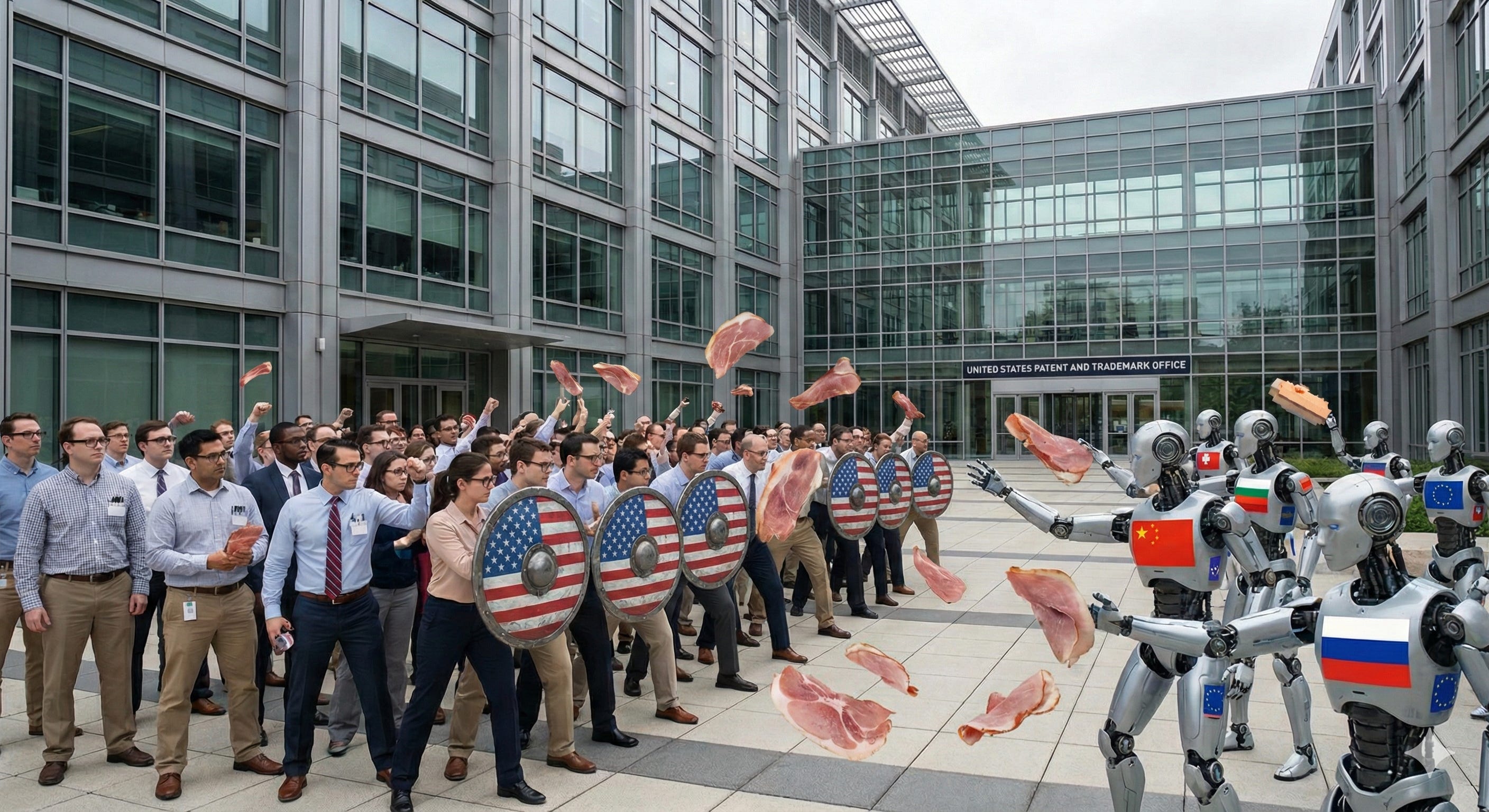
As generative AI tools become increasingly capable of drafting complex technical documents in seconds, the barrier to creating a patent application has collapsed. For a foreign entity, the ability to generate thousands of applications at negligible cost presents a temptation to “spam” the system, hoping a few valuable assets stick.
The USPTO’s proposed rule appears designed to close the accountability loophole that currently makes such a strategy low-risk for foreign actors, effectively placing a registered U.S. practitioner as a “human firewall” between the algorithm and the patent register. There may be some money to be made for practitioners, but the rapidly growing risks are clearly being shifted towards members of the patent bar.
The Accountability Gap: Where AI Meets Anonymity
The central vulnerability the USPTO seeks to address is the “accountability gap” inherent in foreign pro se representation. Currently, a foreign applicant can file an application directly. If that application contains fraudulent data, invented experimental results—a known issue with AI “hallucinations”—or false certifications, the USPTO’s enforcement mechanisms are toothless.
The proposal explicitly highlights this limitation. When dealing with pro se inventor-applicants, the Office notes that “abandonment of the application effectively terminates the USPTO’s ability to gather information” (NPRM, pp. 4-5).
If a bad actor or a reckless AI-driven filing mill is challenged by an examiner, they can simply walk away. The application dies, but the filer remains anonymous and unpunished, free to file again under a different name or entity.
The USPTO candidly admits that “it may be difficult or impossible for the USPTO to establish that the applications are commonly owned or otherwise attributable to the same parties” (p. 5).
This structural weakness creates a perverse incentive for the use of AI in patent prosecution. A foreign entity could theoretically utilize a Large Language Model (LLM) to generate hundreds of prophetic examples or speculative claims, submit them pro se, and see which ones pass initial scrutiny.
The cost of failure is merely the filing fee, with no professional license at risk and no reputational blowback.
The “Human Firewall”: Mandating Liability
By requiring a registered patent practitioner to sign all papers—including amendments, petitions, and information disclosure statements—the USPTO is not just asking for legal competence; it is demanding a hostage.
The proposal makes this logic transparent: “Registered patent practitioners are subject to the USPTO Rules of Professional Conduct and disciplinary sanctions for violations of those rules” (p. 3).
Unlike the transient foreign applicant who can vanish upon abandonment, a U.S. patent attorney or agent has a career and a license anchored to the USPTO. They have “an interest in responding to inquiries and investigations that extends beyond the outcome of a particular application” (p. 4).
This requirement significantly impacts the calculus for AI-assisted filings. If a foreign company wishes to use AI to draft an application, they must now find a U.S. practitioner willing to sign their name to it. That practitioner, bound by Rule 11.18(b), must certify that the paper is not being presented for an improper purpose and that the content has evidentiary support.
A practitioner who rubber-stamps an AI-hallucinated specification without review faces disbarment. Thus, the U.S. counsel becomes the forced quality control layer—the “human in the loop” that the USPTO cannot currently mandate for pro se filers.
Efficiency and the Threat of Volume
The USPTO’s concern is not merely about fraud, but about the sheer physics of processing power. The proposal repeatedly cites “efficiency” as a primary driver, noting that the Office currently “spends extra resources to handle pro se applicants” (p. 2).
The document details the operational drag caused by unrepresented filers: “Applications from pro se inventors generally require additional processing by the Office of Patent Application Processing because the application papers are often not in condition for publication, examination, or both” (p. 3). Furthermore, once these applications reach an examiner, they “usually require patent examiners to spend examination time on procedural matters, thereby increasing overall patent application pendency” (p. 3).
In a pre-AI world, the number of pro se applications was limited by human capacity. A single inventor could only write so much. In the age of Generative AI, that natural cap on volume has evaporated. An automated script could generate compliant-looking (though substantively nonsensical) PDF filings at a scale that would paralyze the Office of Patent Application Processing.
By mandating professional representation, the USPTO reintroduces a bottleneck. The number of filings becomes constrained not by how fast an AI can generate text, but by how many human hours U.S. attorneys have available to satisfactorily review and (electronically) sign them.
Fraud Mitigation: The “Micro Entity” Warning
A specific area where the USPTO appears to be seeing early warning signs of automated or systematic abuse is in fee certifications. The proposal notes “an increase in the number of false micro entity certifications to claim a reduction in fees and other false certification documents being filed” (p. 4).
These false certifications are doubly damaging: they “unjustly diminish the monetary resources of the USPTO” and allow bad actors to “unjustly advance out of turn” (p. 4) through expedited examination programs. An AI trained to minimize costs for its user would logically select “micro entity” status by default unless hard-coded otherwise.
The USPTO argues that “Requiring submissions to be made by registered patent practitioners... will make it less likely that the submissions will be signed by an unauthorized party or contain inaccurate or fraudulent statements” (p. 4).
The practitioner becomes the guarantor of the client’s status. If a foreign entity tries to game the fee system using automated filings, the U.S. attorney is the one who will receive the “fee deficiency notices” and “show cause orders” (p. 4), and they are the ones who must answer.
Analysis: Benefits, Challenges, and Risks
The primary benefit of this proposed rule is the preservation of the patent system’s integrity in the face of technological disruption. By tethering every foreign application to a licensed individual, the USPTO creates a robust mechanism for “fraud mitigation” (p. 4).
This structure disincentivizes “spray and pray” filing tactics and ensures that the Office has a responsive party for every docket. It effectively outsources the labor of policing AI-generated content to the private bar, ensuring that “applications will be in better form for examination” (p. 3) before they ever reach a government employee.
The challenge, as always, is the cost imposed on legitimate innovation. The USPTO estimates that for a small entity to hire U.S. counsel for a non-provisional application, the cost could range from roughly $12,000 to over $19,000 depending on complexity (p. 18). For a solo inventor in a developing nation—or even a small foreign startup using legitimate AI tools to lower costs—this creates a steep paywall.
There is a tension here: the rule aims to stop low-cost, low-quality volume, but in doing so, it may block low-cost, high-quality innovation.
The “1,102 foreign pro se small entities” (p. 13) identified by the Office as being immediately impacted will face a stark choice: pay American legal rates or abandon their U.S. IP rights.
A significant risk is the potential emergence of a “sign-off” or “rubber stamp” market. If the demand for U.S. representation spikes solely to meet this regulatory hurdle, we may see the rise of practitioners who effectively lease their signatures to foreign filing mills for a nominal fee, conducting only cursory reviews of AI-generated work.
While the USPTO warns that “the presentation to the Office of any paper by a party... constitutes a certification” (p. 6), detecting this behavior is difficult until after damage is done. The Office will need to be vigilant in monitoring high-volume practitioners who appear to be filing applications far in excess of human capacity—a sign that they may be serving as nothing more than a front for the very automated systems the rule seeks to contain.
By mandating U.S. representation, the USPTO effectively deputizes private practitioners as the primary defense against AI-driven fraud, exposing them to significant risk if they fall victim to “deepfake” clients or synthetic identities. Under 37 CFR 11.18(b), attorneys certify the legitimacy of every filing, meaning a practitioner who unwittingly submits an AI-hallucinated specification or fraudulent fee certification faces severe disciplinary sanctions for failing to conduct an “inquiry reasonable under the circumstances” (p. 6).
This liability shift will likely force firms to implement aggressive “Know Your Client” protocols to ensure that the “inventor” on the video call is not merely a digital puppet for a high-volume filing mill.
Conclusion
The USPTO’s Notice of Proposed Rulemaking is framed as a procedural update, but it functions as a strategic fortification. By eliminating the foreign pro se avenue, the Office is closing the door on anonymous, unaccountable, and potentially automated filings.
The “efficiency” (p. 2) the Office seeks is likely not just about fixing margin errors, but about preventing the U.S. patent system from becoming a training ground for adversarial AI.
By forcing foreign entities to engage U.S. counsel, the USPTO ensures that for every application entering the system, there is a human professional whose livelihood depends on that application being truthful, accurate, and compliant. In the era of infinite digital generation, that human liability may be the only thing keeping the floodgates closed.
Disclaimer: This is provided for informational purposes only and does not constitute legal or financial advice. To the extent there are any opinions in this article, they are the author’s alone and do not represent the beliefs of his firm or clients. The strategies expressed are purely speculation based on publicly available information. The information expressed is subject to change at any time and should be checked for completeness, accuracy and current applicability. For advice, consult a suitably licensed attorney and/or patent professional.