


Today, the United States Patent and Trademark Office (USPTO) issued a Notice of Proposed Rulemaking that represents a significant shift in how international applicants interact with the American patent system. The proposed rule (to be published as Federal Register 2025-23917 on December 29, 2025) would require all patent applicants, inventors, and patent owners domiciled outside the United States or its territories to be represented by a registered U.S. patent practitioner.
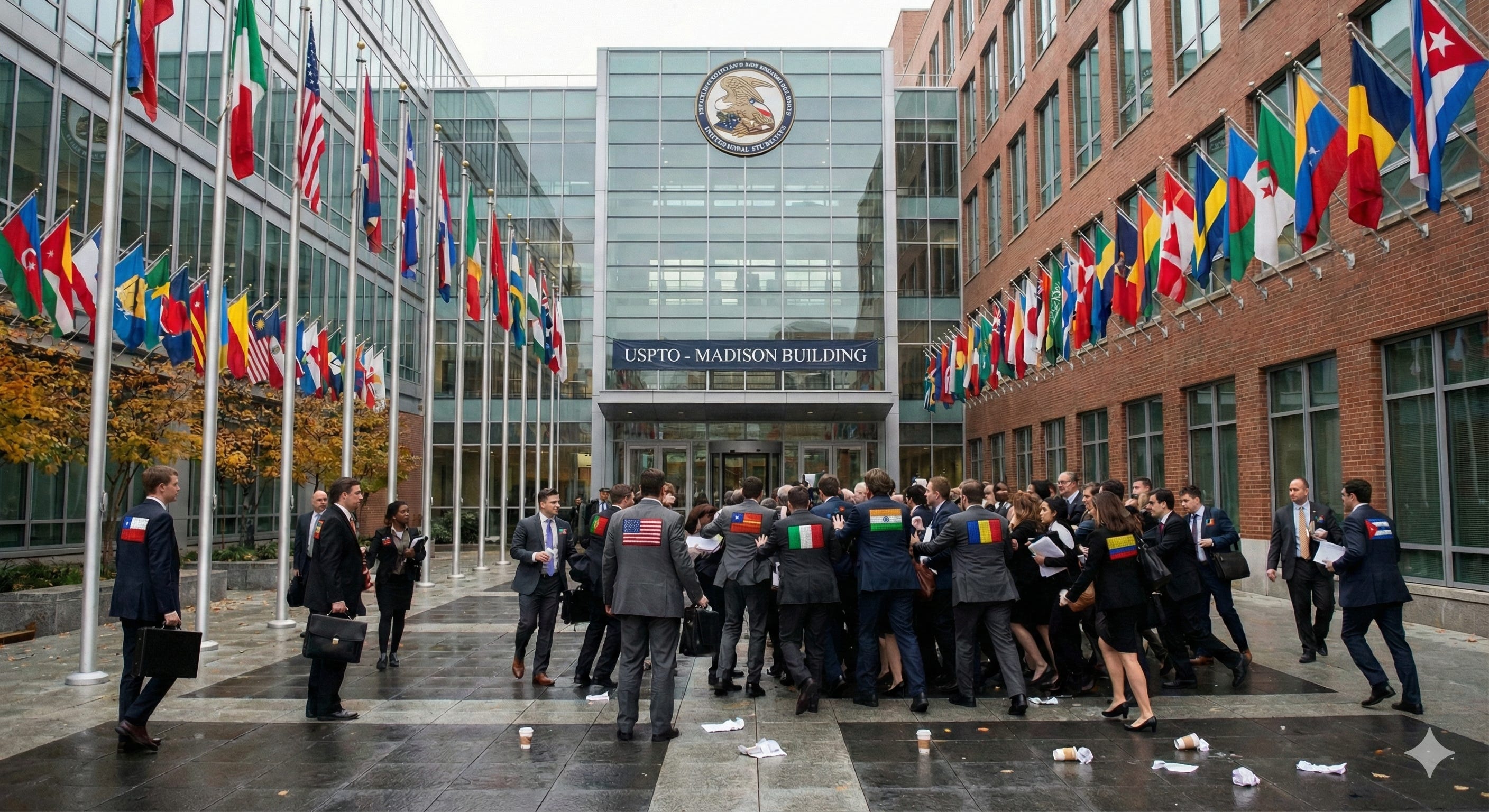
This move is said to align the United States with the standard practices of most major global intellectual property offices, but its primary drivers appear to be domestic concerns regarding administrative efficiency and the integrity of the patent register.
As the USPTO seeks to filter out fraudulent submissions and streamline examination, foreign applicants currently filing pro se—without legal representation—will face new procedural hurdles and associated costs.

The Problems the USPTO Intends to Solve
The USPTO’s proposal is not merely an administrative cleanup; it is a targeted response to specific vulnerabilities allegedly growing within the current filing system.
The text of the proposal identifies three main problem areas: the drain on resources caused by procedurally deficient applications, the difficulty in enforcing compliance against foreign actors, and a rising tide of fraudulent certifications.
1. Operational Inefficiency and Resource Drain
Applications filed without the assistance of a registered practitioner often fail to meet the technical requirements necessary for publication or examination. The USPTO notes that “applications from pro se inventors generally require additional processing by the Office of Patent Application Processing because the application papers are often not in condition for publication, examination, or both” (Proposed Rulemaking, p. 3).
When these deficient applications reach an examiner, the focus shifts from the merits of the invention to administrative cleanup. The Office states that “pro se applications usually require patent examiners to spend examination time on procedural matters, thereby increasing overall patent application pendency” (p. 3)
By mandating professional representation, the USPTO anticipates that applications will arrive in better condition, allowing examiners to focus on the substantive issues of patentability.
2. The Challenge of Enforcement and Accountability
The USPTO currently lacks effective mechanisms to sanction foreign applicants who violate agency rules. When a pro se foreign applicant files a submission that is fraudulent or non-compliant, their distance from U.S. jurisdiction makes disciplinary action difficult. Furthermore, “abandonment of the application effectively terminates the USPTO’s ability to gather information” (pp. 4-5). Once a bad actor walks away from a flagged application, the investigation often ends.
In contrast, registered practitioners are subject to the USPTO Rules of Professional Conduct. They have “a duty to cooperate with inquiries and investigations” (p. 4). By inserting a licensed professional between the foreign applicant and the Office, the USPTO creates a point of accountability.
The Office argues that this “enhances the USPTO’s ability to respond to false certifications, misrepresentations, and fraud” (p. 2).
3. Fraud and False Certifications
Perhaps the most urgent issue cited is the manipulation of fee structures and expedited processing queues. The Office has observed “an increase in the number of false micro entity certifications to claim a reduction in fees and other false certification documents being filed” (p. 4).
These false claims allegedly harm the system in two ways: they “unjustly diminish the monetary resources of the USPTO,” and they allow undeserving applications to jump the line, resulting in “applications being unjustly advanced out of turn” (p. 4).
The premise of the new rule is that a registered practitioner, fearing the loss of their license, will not sign off on fraudulent entity status claims.
The Proposed Framework
Under the proposed 37 CFR 1.31, any applicant or patent owner whose “domicile is not located within the United States... or its territories” must be represented by a registered patent practitioner (p. 1). The term “domicile” is defined as “the permanent legal place of residence of a natural person or the principal place of business of a juristic entity” (p. 6).
The enforcement mechanism is strict. If a foreign applicant attempts to file papers—such as amendments, information disclosure statements, or petitions—without the requisite signature of a registered practitioner, those papers “would not be entered” into the record (p. 5). While the inventor can still sign their own oath or declaration, the prosecution of the application must be handled by counsel.
This requirement extends to post-grant proceedings as well. The proposal notes that while previous rules required juristic entities (corporations) to have counsel during the application phase, the new rule “has now been expanded to make a similar requirement for patent owners in post-grant proceedings” (p. 7).
Economic Implications for Foreign Applicants
While the USPTO argues that this rule will improve system-wide efficiency, it acknowledges the financial impact on individual foreign filers who previously navigated the system alone.
The Office estimates that approximately 1.4% of foreign small entities filing patent applications are currently pro se, amounting to roughly 1,102 affected applications based on FY 2022 data (p. 13).
For these entities, the cost of entry into the U.S. patent system will rise. The USPTO’s analysis suggests that for a foreign applicant to retain U.S. counsel for a non-provisional application—where no foreign counsel provides substantive direction—the costs could be significant.
According to the Economic Survey data cited in the proposal:
Minimal Complexity Applications: The estimated legal cost ranges from “$11,910 to $12,100” (p. 18).
Relatively Complex Applications: For biotech, chemical, or electrical matters, the costs rise to “$14,910 to $17,600” (p. 18).
If the foreign applicant already has foreign counsel who prepares the application and provides detailed instructions to the U.S. practitioner, the costs are lower but still notable, ranging from roughly $4,000 to $5,400 depending on complexity (p. 19).
Thoughts & Analysis
Increased Integrity and Harmonization?
From a systemic perspective, the benefits of this proposal are clear. Bringing the U.S. into alignment with “most other countries that require that such parties be represented by a licensed or registered person” (p. 2) removes an anomaly in international patent practice.
More importantly, it aims to secure the “integrity of the U.S. patent system” (p. 4) by placing a gatekeeper—the registered practitioner—at the entry point. This should theoretically reduce the volume of junk filings and fraudulent fee payments, ensuring that examination resources are deployed more effectively.
The Gen-AI Angle
While the proposal does not explicitly name artificial intelligence, the USPTO’s focus on “efficiency” and “fraud mitigation” (p. 2) directly addresses the risks associated with automated, high-volume filings. The Office notes that pro se applications often fail to meet publication standards and require significant “additional processing” (p. 3), a burden that could intensify if AI tools encourage a flood of technically deficient applications.
By requiring a registered practitioner, the USPTO effectively installs a human gatekeeper liable for the content of every submission. This ensures that a professional subject to disciplinary sanctions verifies the filing, preventing “inaccurate or fraudulent statements” (p. 4) and protecting the “integrity of the U.S. patent system” (p. 4) from unverified, machine-generated errors or hallucinations.
The Definition of Domicile
A potential operational challenge lies in the verification of domicile. The rule states that domicile for an inventor is determined by the “residence information provided in the application data sheet (ADS)” (p. 5). However, if the ADS conflicts with other documents, the Office may need to investigate.
The proposal notes that “the USPTO may refer to the notarized Patent Electronic System Verification form or other identity verification information” (p. 6) to resolve discrepancies.
This suggests that while the rule aims to reduce procedural burdens on examiners, it may create new administrative tasks regarding identity verification in the Office of Patent Application Processing.
Access and Evasion
There is a risk that this requirement may price out legitimate, individual inventors from developing nations who lack the resources to hire U.S. counsel. While the affected group is statistically small (approx. 1,102 entities per year), the barrier to entry for this subset becomes nearly insurmountable without significant capital.
Furthermore, there is a risk regarding how “bad actors” will adapt. While the rule relies on the ethical obligations of practitioners to prevent fraud, it is conceivable that a market for “rubber-stamp” representation could emerge, where practitioners sign off on foreign applications with minimal oversight to capture volume fees.
The USPTO mitigates this by reminding practitioners that “the presentation to the Office of any paper by a party... constitutes a certification under 37 CFR 11.18(b)” (p. 6). Practitioners failing to make a “reasonable inquiry” into the accuracy of their submissions—including the client’s domicile—face sanctions.
The success of this rule depends entirely on the USPTO’s willingness to aggressively enforce these ethical standards against its own registered bar.
Conclusion
The USPTO’s proposed rule is a decisive step toward tightening the security and quality of the U.S. patent register. By mandating that foreign applicants utilize U.S. counsel, the Office aims to “facilitate fraud mitigation” (p. 4) and ensure that examiners are not bogged down by procedurally defective filings.
For U.S. patent practitioners, this proposal likely signals a modest increase in potential clientele, but it comes accompanied by a heightened responsibility to verify the identity and bona fides of foreign clients.
For foreign applicants, particularly small entities and independent inventors, the U.S. patent system is poised to become more professionalized, but inevitably more expensive.
Public comments on this proposed rule must be received 30 days after its publication in the Federal Register (p. 1). Stakeholders—both domestic practitioners and international applicants—should review the rule, especially the proposed definitions of domicile and the enforcement mechanisms carefully before the window for feedback closes in 30 days.
Disclaimer: This is provided for informational purposes only and does not constitute legal or financial advice. To the extent there are any opinions in this article, they are the author’s alone and do not represent the beliefs of his firm or clients. The strategies expressed are purely speculation based on publicly available information. The information expressed is subject to change at any time and should be checked for completeness, accuracy and current applicability. For advice, consult a suitably licensed attorney and/or patent professional.