


The United States Patent and Trademark Office circulated a press release dated April 1, 2026, announcing a fictitious artificial intelligence tool. The agency presented this tool as a solution for patent eligibility determinations under 35 U.S.C. § 101. The publication builds upon genuine, active agency initiatives. The office recently deployed the real Artificial Intelligence Search Automated Pilot Program, or “ASAP!,” for patent prior art references. The office later introduced the real Trademark Classification Agentic Codification Tool, or “Class ACT,” for trademark searching.
The announcement playfully introduced a new agentic system named “McConaughey Agentic Tasking Technology Helping Examiner Workload,” carrying the acronym “MATTHEW.”
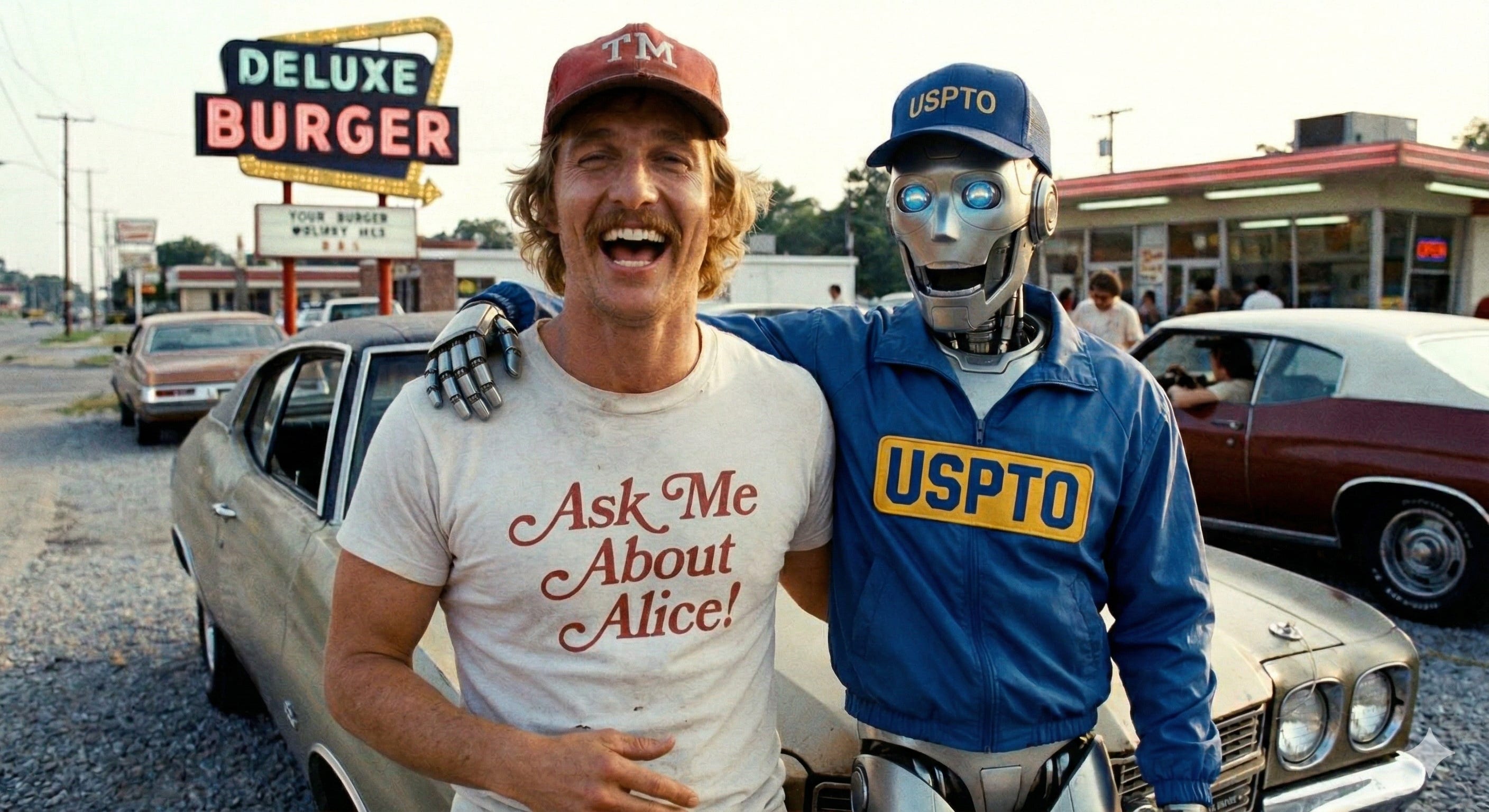
The announcement jokes that this system “will help examiners tackle the thorniest of eligibility questions as to whether claims presented are an abstract idea or a patent-eligible invention” (¶ 1). Good luck!
The Proposed System and the Suspension of Precedent
The parody relies on the complete replacement of existing Supreme Court precedent with an automated, celebrity-themed response mechanism. The publication quotes USPTO Director John A. Squires explaining the operational mechanics of the new system. Director Squires stated the system will “greatly enhance our ability to make the close calls—or any call, really—as I herewith also suspend all applicable precedent, including Desjardins, Alice, and Mayo” (¶ 2).
The director offered a replacement standard rooted entirely in the output of the automated tool: “Basically, in terms of eligibility, if MATTHEW says your invention is ‘Alright, Alright, Alright,’ then it’s ‘Alright, Alright, Alright’ with the USPTO” (¶ 2).
The text addresses the structural shift from a two-part inquiry to a three-part output. The director remarked, “Initially, we had some concerns that we would be introducing a three-part test in place of the two-part test under Alice and Mayo, but I think we’ll be al…um, okay” (¶ 3).
The agency claimed to have evaluated other automated solutions before selecting the current iteration. The publication notes a rejected system titled “Binary Eligibility Engaged Translation Language Environment Joint User Interface Computational Evaluator,” or “BEETLEJUICE” (¶ 4). The director noted “coders had some issues in testing when they said the name three times” (¶ 4).
The McConaughey Connection
The selection of Matthew McConaughey for this parody directly references recent, highly publicized intellectual property filings. Matthew McConaughey’s company, J.K. Livin Brands Inc., registered eight trademarks consisting of “video and audio recordings of McConaughey delivering iterations of his ‘alright alright alright’ and ‘just keep livin’‘ lines.” Reports indicate the strategy attempts to utilize federal trademark protection to address the “unlicensed use of AI-generated McConaugheys in ways that current IP law may not cover.”
These specific multimedia filings exemplify the exact type of non-traditional applications organized under the new Category 30 design search codes. Public figures continuously attempt to construct “the widest possible protective moats” around their personas.
Filings under divisions 30.01 and 30.02 will likely increase, which seems to be what Director Squires wants for the USPTO.

High Stakes and the Reception of Satire
The humor embedded in the announcement originates from a genuine, prolonged legal predicament. The satire functions effectively as a comedic exercise. The stakes feel extraordinarily high for patent owners and applicants. The intellectual property community has endured approximately twelve years of the ambiguous two-step framework established by the Supreme Court. Identifying an abstract idea remains highly subjective. The absence of clear statutory definitions forces patent examiners and federal federal judges to rely on analogous comparisons with previous case law. This analogical reasoning frequently yields inconsistent results across different technology sectors.
Replacing a legal framework with a machine outputting a movie quote perfectly encapsulates the frustration felt by patent attorneys attempting to counsel clients on the likelihood of obtaining patent protection. The joke might be received poorly by practitioners actively struggling to secure rights for software developers and medical diagnostics innovators. For these professionals, the pain of arbitrary rejections is entirely real. A parody originating from the examining agency might appear insensitive to the severe financial and strategic losses caused by the current jurisprudential environment.
The acronym’s explicit reference to “Helping Examiner Workload” introduces an additional layer of potential insensitivity directed at the agency’s internal workforce. The Ninth Circuit recently vacated a preliminary injunction in Am. Fed. of Gov’t Employees v. Trump, resulting in the effective decertification of the Patent Office Professional Association (POPA). The appellate ruling permits Executive Order 14,251 to proceed, categorizing the Patents business unit as executing primary national security functions. Consequently, examiners currently lack a formal collective bargaining agreement. This absence leaves a distinct void regarding established protocols for performance metrics, telework allowances, and grievance procedures. Attempting humor regarding examiner workload during a period where employees operate without union representation. Offering more training hours might make the joke sting less.
Patent examiners and practitioners spend countless hours debating the presence of an “inventive concept” instead of, e.g., focusing on unearthing prior art references. The two-step test frequently conflates eligibility with novelty under Section 102.
The agency’s attempt at humor highlights this structural failure. Software patents face exceptionally high invalidation rates in district courts. The examining corps struggles to maintain uniformity across different art units.
Again, this April Fools joke—without offering additional training and credit—falls a little flat.
Future Implications
Patent professionals must consider the potential impact of such high-profile commentary. Does this prompt the Supreme Court to take up a new case to clarify the standard? Does this inspire Congressional action to codify a modern approach to patentable subject matter? Or does this just remind applicants in the software space that eligibility is just a gamble?
The persistent demand for legislative clarity regarding patentable subject matter remains unfulfilled. As the agency proceeds with testing and implementing real automated tools for prior art searching and classification, the intellectual property community must monitor these technological integrations carefully. The tension between administrative efficiency and rigorous legal analysis requires continuous observation.
Software and diagnostic innovators face prolonged uncertainty. Integrating automated systems into formal legal evaluations requires extreme caution.
The patent system relies upon transparent, articulable legal reasoning. Intellectual property professionals will continue advocating for predictability and stability in securing valuable commercial assets.
Getting stakeholders’ hopes up for a second does not seem alright, alright, alright.
Disclaimer: This is provided for informational purposes only and does not constitute legal or financial advice. To the extent there are any opinions in this article, they are the author’s alone and do not represent the beliefs of his firm or clients. The strategies expressed are purely speculation based on publicly available information. The information expressed is subject to change at any time and should be checked for completeness, accuracy and current applicability. For advice, consult a suitably licensed attorney and/or patent professional.