


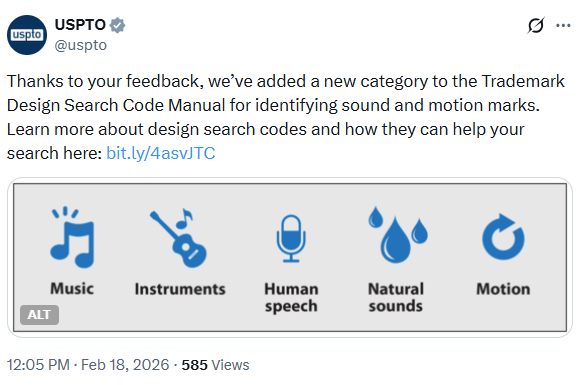
On February 10, 2026, the United States Patent and Trademark Office issued a notification detailing a structural modification to the trademark database. The agency introduced Category 30 into the manual, establishing a dedicated classification for identifying sound and motion marks. Historically, intellectual property professionals faced severe restrictions when querying the database for non-traditional filings.
Practitioners relied heavily on textual keyword queries within the mark description field to locate audio or visual anomalies. The agency indicated that users can now “use design search codes in category 30 to search directly for these marks in the trademark search system instead of searching for key words.”

This revised framework permits direct querying for specific sensory formats, replacing the subjective text-based approach. The update aims to bring precision to clearance searching for non-traditional filings, a development that patent attorneys, trademark practitioners, and in-house counsel should evaluate for immediate integration into standard operating procedures.
Adjusting to these structural changes allows legal teams to adapt their strategies for identifying potential conflicts in the federal register.
The transition from text-dependent inquiries to structured numerical identifiers marks a not-so-insignificant operational shift for those handling non-traditional intellectual property portfolios.
The Mechanics of Design Codes
A comprehensive clearance effort requires identifying existing trademarks that resemble a proposed application and pose a likelihood of confusing consumers regarding the source of goods or services. A design element constitutes “any component of a mark that is not a word, such as an image of a star or flower” (Design Search Codes).
The federal search system currently “doesn’t allow reverse image searching,” making numerical search codes the primary mechanism for isolating non-textual commercial components. Intellectual property owners rely on this numeric methodology to determine if branding investments carry a risk of litigation before pursuing federal registration.
The manual organizes these identifiers into a structured, six-digit numerical system. The first two digits dictate the broad category, the middle two specify a narrower division, and the final two isolate a highly specific section. Practitioners utilize these numbers to evaluate whether proposed applications conflict with existing registrations. Prior to initiating a search, practitioners must “identify the prominent or significant parts of [the] design” (Design Search Codes).
The objective requires finding marks that share a similar appearance, sound, meaning, or overall commercial impression. Finding these similarities prevents businesses from adopting branding that infringes upon existing rights. The USPTO advises searchers to ask “Which features would help [a searcher] pick out a similar trademark?” to guide their strategy.
Applying this mindset to non-traditional sensory properties requires a clear comprehension of the newly implemented numerical divisions. Trademark professionals must train their staff to look beyond traditional literal elements and accurately categorize the sensory impact of a brand asset.
Category 30: Organizing Sound and Motion
Category 30 centralizes non-traditional marks. The official guidance states this category “includes non-traditional marks that feature sound or motion or other acceptable forms of change” (Design search codes Category 30). The instruction manual specifies that this encompasses “elements that grow, fade, flicker, or materialize.”
The classification is divided into two primary divisions: 30.01 for motion and 30.02 for sound. The agency recognized that practitioners “couldn’t refine [their] search results in this way” prior to this system update (Bulletin, p. 2).
By separating audio and visual movement into distinct categories, the administration aims to modernize the public research capabilities for assets that do not fit standard figurative or literal molds. This restructuring provides a designated space for the increasing volume of modern, multi-sensory branding applications submitted by corporations and independent inventors.
Motion Marks (Division 30.01)
Division 30.01 isolates motion-based trademarks. According to the manual, “Motion marks must be shown in drawings of 1-5 frames of visual elements” (Category 30, p. 1). The guidelines direct that these visual frames “should [additionally] be coded using traditional figurative design codes as applicable” (Category 30, p. 1). Motion marks feature diverse executions:
“The letters in the mark move, scrambling to form a new word” (Category 30, p. 2).
“Lights blink in sequence on goods” (Category 30, p. 2).
“The mark progresses from a blank background such that the wording emerges and darkens” (Category 30, p. 2).
Trademarks incorporating motion “may or may not feature sound” (Category 30, p. 1). The agency notes that these filings “may include any combination of wording, figurative elements, and sound” (Category 30, p. 1). Patent attorneys reviewing motion marks must account for static visual components, the sequence of the movement, and any accompanying auditory signals. The multi-faceted nature of these applications necessitates a highly methodical clearance strategy.
Sound Marks (Division 30.02)
Division 30.02 organizes audio trademarks based on their origin. The USPTO assigns numerical identifiers “according to the nature or source of the sound(s) they contain” (Category 30, p. 1). Examples of these sources include “musical instruments, human speech, animals, or machines.”
The application rules state that “Mark drawings are not required for sound marks” (Category 30). The search database typically presents these filings using “placeholders labeled as ‘No drawing’.” Some records depict sensory marks by integrating “visual representations of notes or language in the place of the drawing placeholders.”
The agency frequently categorizes these auditory filings as “sensory” or “non-visual” marks within the database environment (Category 30). The lack of standardized visual representations for audio makes accurate coding an absolute necessity for future discoverability.
The manual establishes seven distinct sections for audio marks, each requiring careful review by legal professionals assessing new filings:
30.02.01 (Musical Sounds): This section covers non-vocal audio “that can be rendered with musical notation.” Examples include a sequence of “three chime-like musical notes.”
30.02.02 (Human Speech and Singing): This grouping captures sounds “creating intelligible words or syllables.” The instruction dictates that audio forming words belongs here “[regardless of whether] they are purportedly made by animals, robots, etc.”
30.02.03 (Other Human Sounds): This section manages audio “not intelligible enough to be rendered as speech or syllables.” The manual lists examples such as clapping, breathing, sneezing, and whistling.
30.02.04 (Animal Sounds): This classification houses animal noises. The manual instructs that audio imitating animals receives this identifier “[regardless of whether] they are purportedly made by humans.” Recorded examples feature a “lion roaring” or “five chirps imitating the sound of a cricket.”
30.02.05 (Natural Elements): Sounds originating from environmental phenomena fall under this section, covering weather, wind, water, and fire. Examples include the sound of an “ocean wave crashing” or “rippling and bubbling water.”
30.02.06 (Objects and Machinery): This tier captures mechanical and electrical noises, ranging from a “weeping siren tone” to “electric crackling, buzzing, snap, and whirring.”
30.02.07 (Other Sounds): This final option functions as a default repository for audio marks that do not fit prior classifications. It is frequently assigned automatically “when marks with sound are initially filed.”
The McConaughey AI Trademarks
Recent developments highlight the growing relevance of the USPTO’s new structural classifications. Matthew McConaughey’s company, J.K. Livin Brands Inc., registered eight trademarks consisting of “video and audio recordings of McConaughey delivering iterations of his ‘alright alright alright’ and ‘just keep livin’‘ lines” (Bloomberg Law). Reports indicate that the strategy attempts to utilize federal trademark protection to address the “unlicensed use of AI-generated McConaugheys in ways that current IP law may not cover.”
These specific multimedia filings exemplify the exact type of non-traditional applications that the new Category 30 design search codes organize. As public figures attempt to construct “the widest possible protective moats” around their personas, filings under divisions 30.01 and 30.02 will likely increase.
Jonathan Pollack, McConaughey’s attorney, told Bloomberg that trademarks inherently “protect consumers from knockoffs—which is what AI is.” The actor’s legal strategy asserts that “mimickry of McConaughey would be similar enough to the core of the mark—his dynamic persona—to confuse consumers, regardless of the particular words the AI-version says.”
The tactic faces skepticism. A potential challenge to these marks involves whether the audio and visual clips qualify as “use in commerce,” an absolute requirement for trademark validity. The touchstone for infringement requires a likelihood of consumer confusion regarding a specific source identifier, meaning AI-generated content that evokes a voice and likeness without exactly replicating the registered mark may fall beyond the practical reach of trademark law.
For intellectual property practitioners, this news signals a potential influx of defensive audio and motion registrations. Attorneys conducting clearance searches using the new Category 30 parameters should anticipate encountering these celebrity filings.
Analysis of Benefits, Challenges, and Risks
The integration of Category 30 introduces functional upgrades for patent attorneys and in-house counsel evaluating intellectual property portfolios. A structured approach to sensory filings offers distinct efficiency advantages. Before this update, a clearance search for an audio application required guessing the exact terminology a prior applicant might have entered into the text fields, often resulting in hours spent reviewing irrelevant search returns.
The new structure permits users to search specifically for auditory types. Practitioners evaluating a proposed mechanical sound mark can immediately query section 30.02.06 to isolate similar mechanical and electrical audio filings. This targeted capability provides a clearer picture of the existing register, supporting more confident legal opinions regarding the likelihood of confusion.
Filtering search parameters by coordinated classes offers an extra layer of refinement for these queries, generating highly specific results that assist inventors in assessing market availability before investing resources into application fees.
A systematized approach is beneficial, yet classifying subjective sensory inputs poses operational challenges. The USPTO observes that “sound marks often combine multiple sounds” (Category 30, p. 1). The agency acknowledges that “the distinctions between types of many sounds may be blurry” (Category 30, p. 1). This blurriness complicates the search process. Distinguishing between a brief musical arrangement and an electronic chime requires subjective judgment. The manual explicitly notes that “Many chimes, electronic chirps, and other similar sounds of few notes are coded under 30.02.06” (Category 30, p. 2), overlapping with musical classifications.
A secondary technical challenge involves the placement of text within the database fields. The administration warns that “Language in marks with sound is sometimes not rendered in the mark literal field, but rather only in the pseudo mark information” (Category 30, p. 1).
Intellectual property professionals conducting searches must adjust query parameters to capture data across both text fields to locate all relevant wording, adding an extra step to the verification process.
The implementation of specific parameters creates risks related to search methodology. An over-reliance on a single six-digit code invites the possibility of missing conflicting marks. The distinctions between audio categories frequently overlap, making a clearance search limited strictly to one section inadequate. The manual directs that comprehensive results “may require use of cross coding” (Category 30, p. 1), combining multiple related design identifiers.
Practitioners risk generating incomplete clearance reports if they fail to execute “combination searching” (Category 30, p. 1), which involves querying multiple codes “together” and “separately” (Category 30, p. 1).
Motion marks present an additional hazard. The agency mandates that the visual frames within a motion mark require coding under “traditional figurative design codes” (Category 30, p. 1). A searcher evaluating a new motion mark who only queries Division 30.01 risks overlooking static design marks that closely resemble the individual frames of the motion sequence.
A failure to cross-reference the motion elements with traditional image identifiers leaves a significant vulnerability in the clearance analysis, exposing intellectual property owners to unforeseen infringement claims or office actions.
Conclusion
The introduction of Category 30 provides a structured framework for non-traditional trademarks. Replacing keyword dependency with designated identifiers for sound and motion marks offers legal professionals a refined method for evaluating market availability. The system promotes increased accuracy in isolating sensory intellectual property.
This administrative update aligns with Director Squires’ many initiatives to signal that the USPTO remains open for business regarding modern intellectual property protection. The new classification reflects an institutional effort to position the agency as a facilitative partner eager to accommodate unconventional brand assets in an evolving era.
The subjective nature of audio and visual interpretations dictates that practitioners must maintain rigorous, multi-code search strategies. Recognizing the blurry boundaries between sound categories and the necessity of cross-coding visual frames supports a comprehensive approach to trademark clearance.
Legal professionals adapting to these new parameters position themselves to better protect innovative brand assets, mitigating litigation risks before entering commercial markets.
Disclaimer: This is provided for informational purposes only and does not constitute legal or financial advice. To the extent there are any opinions in this article, they are the author’s alone and do not represent the beliefs of his firm or clients. The strategies expressed are purely speculation based on publicly available information. The information expressed is subject to change at any time and should be checked for completeness, accuracy and current applicability. For advice, consult a suitably licensed attorney and/or patent professional.