


Earlier in July, the World Intellectual Property Organization (WIPO) introduced an AI-assisted search feature within its PATENTSCOPE database. Billed as a tool to streamline the search process by translating natural language into structured queries, the system represents an incremental step in integrating large language models (LLMs) into public patent research tools.
For patent attorneys, in-house counsel, and inventors accustomed to precise boolean logic and classification codes, evaluating these early-stage AI implementations requires a pragmatic approach.
The current iteration, designated Version 1.0, is functional but limited. However, its foundational architecture and WIPO’s outlined development roadmap suggest it warrants observation as the technology matures.
Current Functionality: Natural Language Processing as a Bridge
At present, PATENTSCOPE’s AI assistant functions primarily as a natural language processing (NLP) interface that maps conversational instructions to standard boolean search parameters. Users input descriptive sentences, and the system generates a corresponding query string.
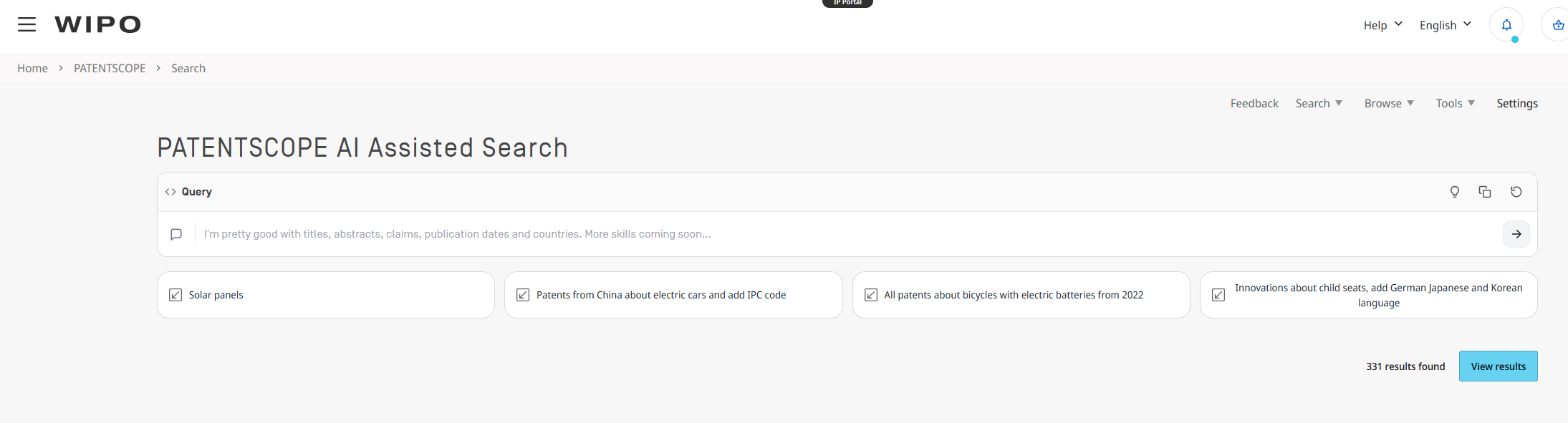
The tool currently focuses on keyword extraction, publication date filtering, and country code identification. For example, WIPO suggests prompts such as “Solar panels with efficiency improvements from 2022” or “Bicycle innovations with electric batteries in German or Japanese.” The AI parses these phrases, identifies the core concepts, and formats them into syntax compatible with PATENTSCOPE’s existing search engine.
As depicted in WIPO’s interface, the input field explicitly states its current parameters: “I’m pretty good with titles, abstracts, claims, publication dates and countries. More skills coming soon...”
For experienced practitioners, this NLP-to-boolean translation may seem rudimentary. Skilled searchers often formulate complex queries faster and with greater precision directly within the advanced search interface.
The immediate utility of Version 1.0 appears targeted toward novice inventors, business stakeholders, or professionals conducting preliminary, high-level novelty checks where immediate precision is less critical than broad initial exposure to a technology area.
Accessibility and Implementation Mechanics
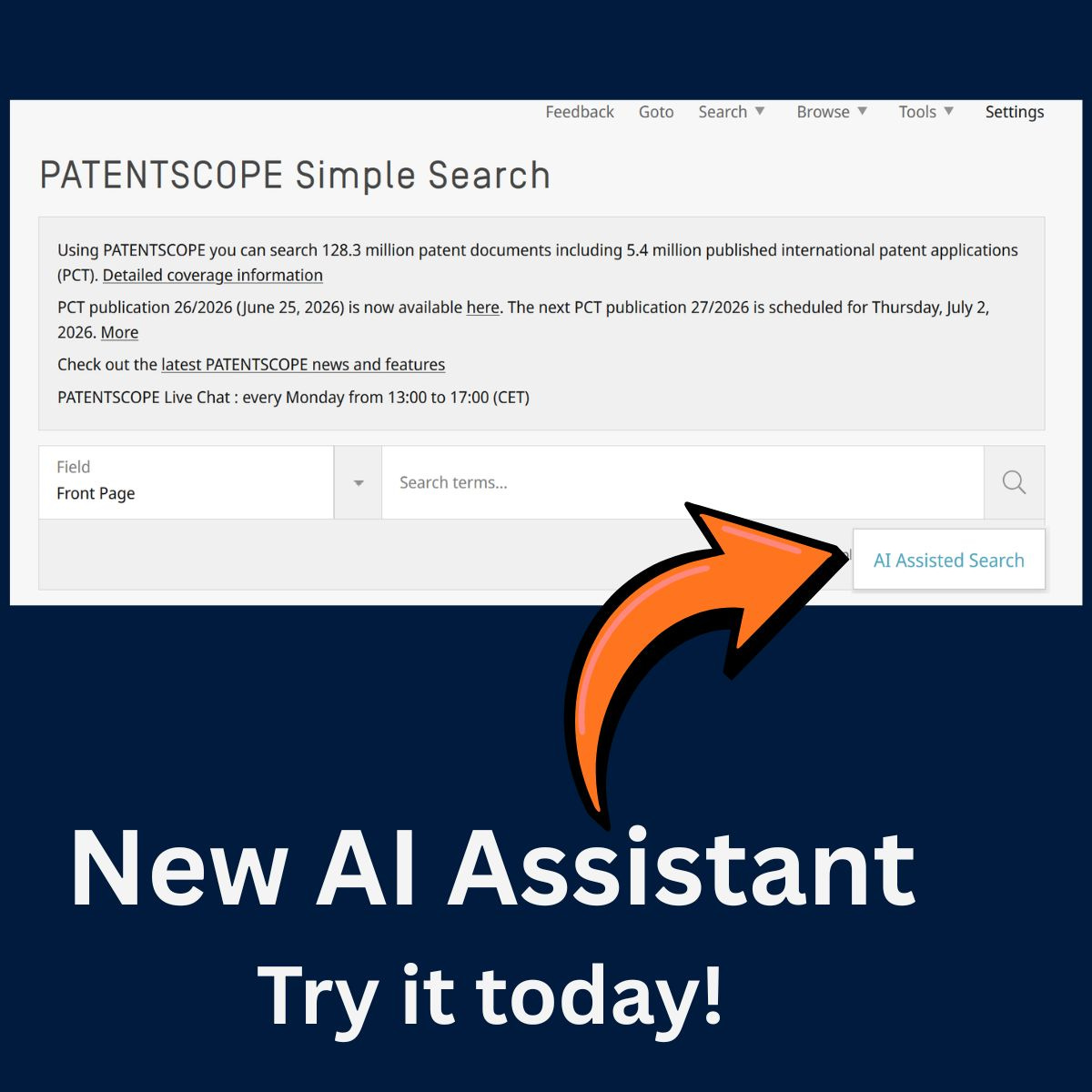
The AI-assisted search is available to the public at no cost, which aligns with WIPO’s mandate to disseminate patent information. Accessing the feature requires users to create and log into a free WIPO account. Once authenticated, the tool is accessible via a distinct button located near the main search bar within the Simple Search interface.
WIPO has structured the interaction to be iterative. Users can enter an initial prompt, review the generated query and preliminary results, and then refine the query by adding further natural language instructions.
This iterative refinement process attempts to mimic a conversational interaction with a search specialist, though the current execution relies heavily on the user’s ability to articulate their needs using terms the system accurately recognizes and translates.
Security and Confidentiality Considerations
A significant concern when utilizing third-party AI tools for patent research—particularly during the early stages of invention prior to filing—is data security. Inputting proprietary concepts or targeted search strategies into commercial LLMs can risk unintended disclosure or data retention.
WIPO addresses this valid concern directly. The organization states:
The language model is hosted on WIPO premises. Your search queries are kept confidential and executed only on WIPO servers.
This localized hosting model offers a substantial advantage over cloud-based AI tools where data privacy policies can be opaque or subject to change.
Furthermore, WIPO has explicitly stated that they do not analyze user logs for the purpose of training or improving the AI. While this protects user confidentiality, it creates a feedback vacuum for the development team.
As always, check with the appropriate attorneys before entering confidential information in a search.
The Development Roadmap and Future Capabilities
Recognizing the limitations of Version 1.0, WIPO has outlined planned enhancements. Future iterations aim to incorporate more sophisticated search parameters, including:
Applicant and assignee name searches
Standard Essential Patent (SEP) queries
Patent number searches
The inclusion of SEP queries could be particularly useful, given the specialized nature of identifying patents declared essential to industry standards.
Because WIPO is not analyzing user logs to protect confidentiality, the development team relies entirely on direct user feedback to expand the tool’s capabilities. WIPO is actively soliciting input regarding query patterns that users would find valuable.
Practitioners concerned about revealing active research strategies are encouraged to provide generic query patterns or structural examples that represent their typical search methodologies.
This feedback can be submitted via an in-app button or directly via email. WIPO also plans to host webinars to further explain the tool and likely gather additional user perspectives.
Thoughts & Considerations
Before integrating this tool into standard operating procedures, IP professionals should weigh the potential benefits against the current limitations and inherent risks.
The primary benefit of PATENTSCOPE AI Version 1.0 is accessibility. It lowers the barrier to entry for individuals unfamiliar with complex patent search syntax. The local hosting of the LLM provides a secure environment for initial, exploratory searches without the confidentiality risks associated with public AI models.
Additionally, its integration into an existing, comprehensive database (PATENTSCOPE contains over 128 million documents) provides a vast corpus for these initial queries.
The main challenge lies in the tool’s current lack of sophistication. Translating a sentence into a basic boolean string often misses the nuance required for a comprehensive prior art or freedom-to-operate search. It cannot currently synthesize information, read claims contextually, or identify non-obvious synonyms in the way an experienced searcher or more advanced, dedicated AI patent tools attempt to do. Relying solely on this tool could result in missed references due to its reliance on direct keyword mapping from the user’s prompt.
The most significant risk is over-reliance by less experienced users. While the archetecture likely does not open the door to hallucinations (e.g., linking each document), a novice inventor or business analyst might assume that a natural language query executed through an “AI Assistant” constitutes a comprehensive search.
If the tool translates a poorly phrased prompt into a narrow boolean query, the resulting clean search report could create a false sense of security regarding novelty or freedom to operate.
Furthermore, while WIPO maintains the confidentiality of the queries, the generated boolean strings themselves become part of the search history within the user’s account. While standard practice, professionals should remain mindful of what information is logged even in secure systems.
Observation Strategy
The current iteration of WIPO’s PATENTSCOPE AI is a rudimentary translation tool rather than a comprehensive analytical engine. It does not yet replace the need for skilled patent searchers or specialized patent analytics platforms.
However, its secure architecture and the institutional backing of WIPO suggest it is a platform worth observing. As the tool evolves beyond basic NLP-to-boolean translation and begins to incorporate features like SEP identification and contextual claim analysis, its utility for IP professionals will likely increase.
This humble blogger would like to be able to edit the boolean search once it is performed, rather than merely filtering results. Interacting with an LLM and instructing it to add more words would be a logical next feature.
Providing generic feedback to WIPO during these early stages may help shape a tool that eventually serves as a useful, secure supplement to established search methodologies.
Disclaimer: This is provided for informational purposes only and does not constitute legal or financial advice. To the extent there are any opinions in this article, they are the author’s alone and do not represent the beliefs of his firm or clients. The strategies expressed are purely speculation based on publicly available information. The information expressed is subject to change at any time and should be checked for completeness, accuracy and current applicability. For advice, consult a suitably licensed attorney and/or patent professional.