


The United States Patent and Trademark Office (USPTO) has issued revised guidance regarding the determination of inventorship for AI-assisted inventions, effectively rescinding the previous framework published in the Federal Register (2024-02623) on February 13, 2024 (“2024 Guidance”). The new guidance (2025-21457), published November 26, 2025 (“2025 Guidance”), clarifies that the legal standard for inventorship remains consistent across all technologies and does not require a modified approach simply because artificial intelligence tools are utilized.
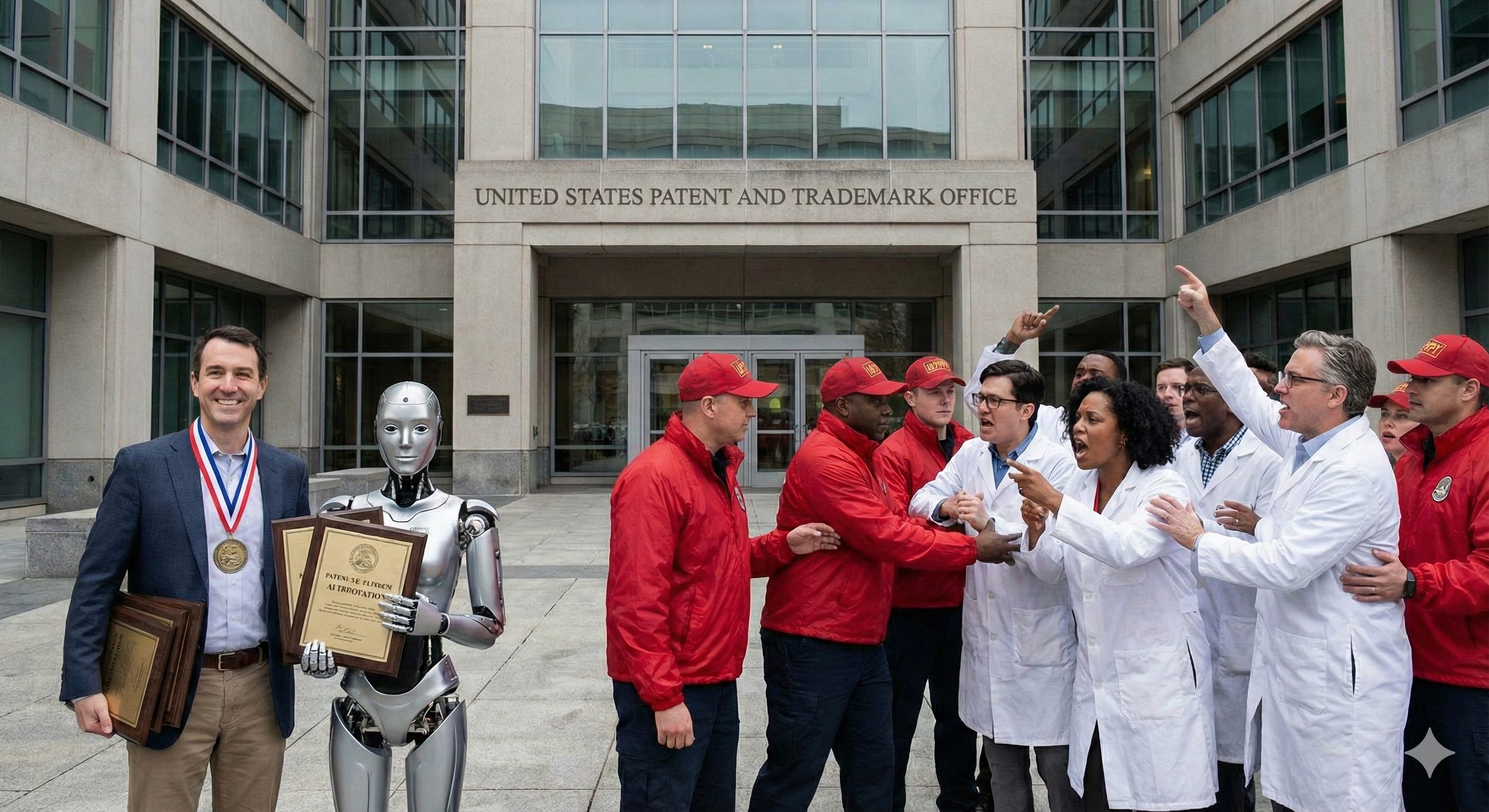
This shift appears to align with broader executive initiatives to promote American innovation with the “Genesis Mission” Executive Order (EO). Genesis Mission appeared to imply that AI agents will be working (and inventing) independently, which appeared at odds with the USPTO’s 2024 Guidance.
The 2025 Guidance, moving away from the stricter scrutiny applied in the 2024 framework, addresses some of those inconsistent feelings. As the USPTO states, the new document “rescinds the previously published Inventorship Guidance for AI-Assisted Inventions and replaces it” (2025 Guidance, p. 1).
The Pivot Away from Pannu for Single Inventors
The most substantial legal adjustment in the 2025 Guidance is the withdrawal of the Pannu factors for analyzing single-inventor scenarios. The 2024 Guidance relied on the application of factors from Pannu v. Iolab Corp. to determine if a human provided a “significant contribution” to an AI-assisted invention.
It stated that while Pannu is generally applied to joint inventors, “it follows that a single person who uses an AI system to create an invention is also required to make a significant contribution... to be considered a proper inventor” (2024 Guidance, p. 6).
The USPTO now clarifies that the Pannu factors are relevant only when determining joint inventorship among multiple natural persons. The Office explicitly notes that “Pannu is inapplicable when only one natural person is involved in developing an invention with AI assistance because AI systems are not persons and therefore cannot be ‘joint inventors’ so there is no joint inventorship question to analyze” (2025 Guidance, pp. 1-2).
Consequently, when a single natural person creates an invention using AI, the inquiry is straightforward: “whether that person conceived the invention under the traditional conception standard” (2025, p. 3). There is no “joint inventorship” question to analyze.
If multiple humans are involved, traditional joint inventorship principles apply to the human contributors to determine their respective status, considering whether “each purported inventor must ‘(1) contribute in some significant manner to the conception or reduction to practice of the invention’” (2025, p. 4).
Key Differences: 2024 Guidance vs. 2025 Guidance
The 2025 guidance represents a notable loosening of the administrative requirements for patent applicants using AI.
Applicability of Pannu:
2024 (Rescinded): Explicitly required that natural persons make a “significant contribution” to the invention, utilizing the Pannu factors to police the boundary between human and machine contribution. It warned that “a rejection under 35 U.S.C. 101 and 115 should be made for each claim... [where] a named inventor... did not significantly contribute” (2024, p. 6).
2025 (Current): States that the previous approach “which relied on the application of the Pannu factors to AI-assisted inventions, is withdrawn” (2025, p. 1). The focus is solely on whether the human conceived the invention.
Scrutiny of Contribution:
2024 (Rescinded): Placed a heavy emphasis on a claim-by-claim analysis to ensure a natural person significantly contributed to every claim. It provided specific “Guiding Principles,” noting that “Merely recognizing a problem or having a general goal or research plan to pursue does not rise to the level of conception” (2024, p. 6).
2025 (Current): Returns to the “touchstone of inventorship,” which is conception. It reiterates that conception is complete when “the inventor has a specific, settled idea, a particular solution to the problem at hand, not just a general goal or research plan” (2025, p. 2). While the requirement for human conception remains, the guidance removes the specific AI-focused litmus tests found in the previous iteration.
Scope:
Both: Confirm that the guidance applies to utility, design, and plant patents (2024, p. 7; 2025, p. 4).
Both: Confirm that AI systems cannot be named as inventors (2024, p. 3; 2025, p. 2).
Judicial Scrutiny: Will the Removal of Pannu Survive in Federal Court?
Legal practitioners may question whether stripping the Pannu requirement for single inventors will survive judicial review, or if it exposes patents to new validity challenges. On balance, the 2025 guidance likely stands on firmer statutory ground than its predecessor, though it shifts the litigation risk to the factual sufficiency of “conception.”
The 2024 guidance occupied a legally precarious position by applying Pannu—a test derived from 35 U.S.C. § 116 regarding joint inventors—to single-inventor scenarios. Critics argued this created a “legal fiction” by treating AI as a quasi-collaborator that must be weighed against the human.
By clarifying that “AI systems are not persons and therefore cannot be ‘joint inventors’ so there is no joint inventorship question to analyze” (2025, p. 2), the USPTO aligns strictly with the Federal Circuit’s holding in Thaler v. Vidal that “only a natural person can be an inventor” (2024, p. 3). A court would likely agree that applying a joint inventorship test to a non-entity was a category error.
However, removing the “significant contribution” guardrail may invite scrutiny regarding conception. Without the Pannu factors to police the boundary, courts must rely solely on whether the human formed “a definite and permanent idea of the complete and operative invention” (2025, p. 2).
Litigators may argue that a human who merely prompts an AI does not possess this “definite and permanent idea” until the AI delivers it, potentially rendering the conception “simultaneous” or derived. While the guidance asserts that recognizing a solution is insufficient, the lack of a “significant contribution” test means the evidentiary burden will focus entirely on the human’s mental state and possession of the invention.
Ultimately, the 2025 guidance is administratively cleaner, but it places immense weight on the definition of “conception.” If patent owners cannot show they possessed the specific details of the invention before or during the AI’s operation—rather than just adopting the output—courts may invalidate patents not for improper inventorship, but for lack of true conception.
AI as an Instrument, Not a Collaborator
The updated guidance reinforces the position that AI systems, including generative models, are instruments used by human inventors.
A primary concern regarding the Genesis Mission was the semantic and legal gap between the Executive Order’s “AI agents” and the Patent Office’s requirement for human contribution. The fear was that an “autonomous agent” doing the work of exploration and evaluation would leave no room for a human inventor under the strict scrutiny of the 2024 guidance.
The USPTO draws a direct analogy between AI and other research tools, stating they are “analogous to laboratory equipment, computer software, research databases, or any other tool that assists in the inventive process” (2025, p. 3).
The 2025 Guidance cites several (older) cases to affirm that inventors may “use the services, ideas, and aid of others” without those sources becoming co-inventors (2025, p. 3).
The USPTO applies this principle to AI: while these systems may generate ideas or provide services, they remain tools in the hands of the human who creates the “definite and permanent idea of the complete and operative invention” (2025, p. 2).
The Department of Energy’s November 24, 2025, press release also framed the AI initiative with more nuance of humans using an instrument rather than “agent.” The DOE’s “instrument” narrative positions AI as merely a sophisticated tool, akin to a microscope or telescope, which can “double the productivity” rather than replace human discovery.
Now, it looks like all the mission-critical parties in Genesis are on board.
Further Thoughts & Analysis
IP professionals should view this update with cautious optimism. The primary benefit is a reduction in administrative ambiguity. By treating AI as a standard tool—much like a complex microscope or a CAD program—the USPTO removes the burden on practitioners to perform a complex “significant contribution” audit for every claim generated with AI assistance. This likely lowers the barrier to patenting for inventors who heavily utilize generative design tools.
However, risks remain. The “conception” standard requires a “definite and permanent idea” or a “specific, settled idea... not just a general goal or research plan” (2025, p. 2; citing Burroughs Wellcome Co. v. Barr Labs., Inc., 40 F.3d 1223).
Over-reliance on AI could lead to scenarios where an applicant believes they have invented something, but they effectively possess only a general goal or research plan, which is insufficient for conception. If the AI provides the specific solution and the human merely recognizes it without mental formation, validity issues could arise in litigation.
If a Genesis Platform user inputs a prompt (”Find a superconductor”) and the AI outputs a molecule, the user must still mentally possess the complete invention. The Guidance warns that “Absent such a description [with particularity], an inventor cannot objectively prove possession of a complete mental picture” (2025, p. 3).
Conclusion
The 2025 Guidance aligns the patent system with the executive branch’s scientific goals. By treating AI as an “instrument” and removing the Pannu analysis for sole inventors, the USPTO has cleared the path for the Genesis Mission’s output to be patentable.
The 2025 guidance signals a return to fundamental patent law principles, stripping away the AI-specific hurdles introduced in 2024. The USPTO emphasizes that “conception is the touchstone of inventorship” and that AI is merely a sophisticated tool (2025, p. 2).
IP professionals must ensure that while their clients use these powerful tools to accelerate discovery, the human mind remains the ultimate vessel where the invention is formed. Practitioners should continue to inquire whether a human inventor had a specific, settled idea of the solution, rather than just a general goal. While the filing process may be streamlined, the duty of disclosure regarding material information remains in effect.
Patent attorneys should ensure that the human inventor—and not the machine—truly possesses the mental picture of the invention. The tools have changed, but the requirement for a “definite and permanent idea” (2025, p. 2) stands firm.
Disclaimer: This is provided for informational purposes only and does not constitute legal or financial advice. To the extent there are any opinions in this article, they are the author’s alone and do not represent the beliefs of his firm or clients. The strategies expressed are purely speculation based on publicly available information. The information expressed is subject to change at any time and should be checked for completeness, accuracy and current applicability. For advice, consult a suitably licensed attorney and/or patent professional.