


In mid-April 2026, the United States Patent and Trademark Office made a “Practitioner Signature Announcement” on the Patent Center information page implemented an update to the Web Application Data Sheet (ADS) interface. The regulatory adjustment blocks the electronic mechanism and strictly forbids sponsored support staff from inserting a practitioner’s signature on any submitted correspondence.
The official agency notice states, “Sponsored support staff are not permitted to insert a practitioner’s signature on any correspondence submitted to the USPTO” (Announcement, ¶ 1). The technical interface modification eliminated the option to insert registration numbers in the signature section for users lacking specific practitioner credentials.
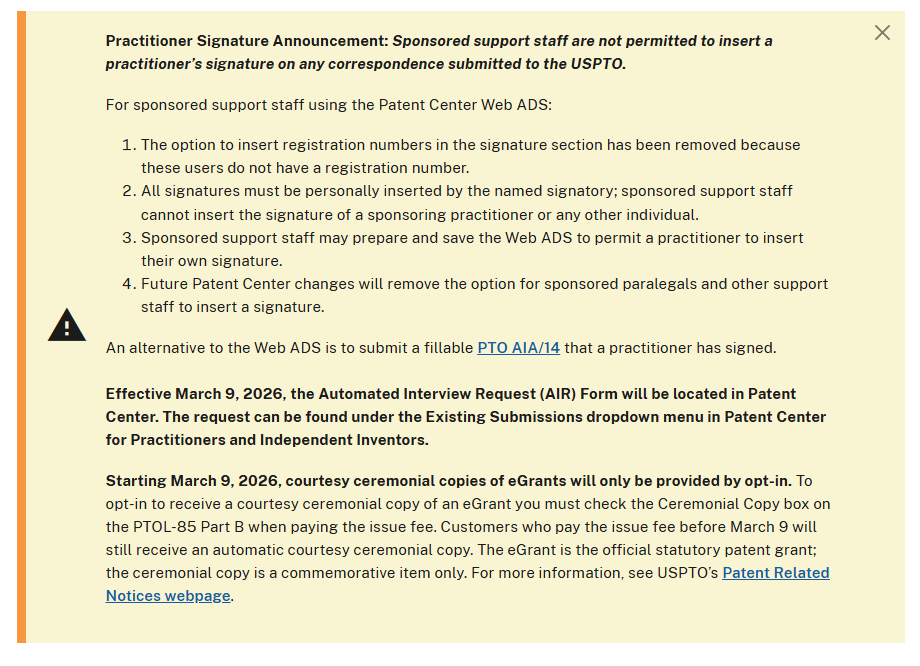
The USPTO explicitly notes that “all signatures must be personally inserted by the named signatory” and that “sponsored support staff cannot insert the signature of a sponsoring practitioner or any other individual” (¶¶ 2, 4).
The notification forecasts further restrictions, indicating that “future Patent Center changes will remove the option for sponsored paralegals and other support staff to insert a signature” across the entire platform (¶ 6).
The agency provided a specific alternative workflow for law firms utilizing administrative personnel. The notice specifies that “sponsored support staff may prepare and save the Web ADS to permit a practitioner to insert their own signature” (¶ 5).
Some practitioners will notice that the USPTO provides an “alternative to the Web ADS is to submit a fillable PTO AIA/14 that a practitioner has signed.” The USPTO has long permitted an “S-signature” that “is a signature that is inserted between forward slash marks by the signer and is not a handwritten signature” (Fed. Reg. 2024-06126). Signing the PDF form with an S-signature obviates this manual sign-in and e-signature process, but could be a workflow shake-up for some firms.
These mechanical changes require attorneys to log into the system and authenticate documents individually, preventing the bulk submission processes that many high-volume practices formerly utilized.
The implementation of this signature procedure is fully active today. The procedural change functions as a direct administrative barrier preventing the utilization of automated signing protocols by artificial intelligence agents, such as Claude, ChatGPT, Gemini, and Open Claw.
Two years ago, in April 2024, the USPTO’s “Guidance on Use of Artificial Intelligence-Based Tools in Practice…” (Fed. Reg. 2024-07629) indicated a signature of a “person” is required:
Generally, all patent correspondence filed in the USPTO must bear a person’s signature. By including this signature, the individual inserting the signature or submitting the paper is certifying that the person’s signature appearing on the document was actually inserted by that person. In other words, a person, including a practitioner, must insert their own signature on the paper. “The requirement does not permit one person (e.g., a secretary) to type in the signature of a second person (e.g., a practitioner) even if the second person directs the first person to do so”
Patent professionals and industry observers detect the USPTO preparing for a substantial influx of AI-drafted patent applications. By mandating manual (electronic) signature insertion by the registered practitioner for such filings, the agency introduces deliberate friction into the prosecution process.
The restriction appears strategically formulated to throttle the volume of submissions. It forces attorneys to review and sign documents personally, effectively neutralizing fully autonomous AI filing pipelines that might otherwise submit thousands of applications without human intervention.
The patent office perceives this manual bottleneck as a necessary measure to keep the anticipated deluge of machine-generated filings manageable. Slowing down the attorneys serves as a primary method to control the influx of new applications.
This administrative update correlates strongly with other recent USPTO initiatives targeting procedural authenticity and accountability. A related policy shift involves the final rule requiring patent applicants and patent owners domiciled outside the United States to secure representation by a registered U.S. patent practitioner.
The Federal Register notice for the foreign counsel rule states the requirement aims to “enable the USPTO to more effectively use available mechanisms to enforce compliance... and enhance the USPTO’s ability to respond to false certifications” (Fed. Reg. 2026-05564).
Both the signature limitation and the foreign counsel requirement operate as structural methods to curb fraudulent filings. By affirming and/or establishing strict requirements for who can file and who must sign, patent administrators are constructing a defense against a predicted wave of unverified submissions that could overwhelm the examination corps.
The agency is applying friction points at the very beginning of the application lifecycle to verify the human origin and professional oversight of the submitted materials.
Before concluding an assessment of these regulatory shifts, analyzing the benefits, challenges, and risks of the Patent Center signature limitations provides a comprehensive perspective for IP owners and practitioners.
Benefits
Implementing strict manual (electronic) signature requirements yields distinct procedural advantages for the patent ecosystem. It preserves the integrity of the patent system by forcing a licensed human practitioner to authenticate each submission individually. This verification step limits the capacity for bad actors to flood the office with automated, low-quality filings generated entirely by artificial intelligence software.
The mandate allegedly protects the public interest by enforcing strict adherence to the rules of professional conduct. It holds practitioners directly accountable for the contents of the Web ADS and related correspondence, reducing the likelihood of careless errors or intentionally deceptive data entering the official record.
Challenges
The administrative burden on patent practitioners and their firms increases significantly. Attorneys must now manually execute routine documents that paralegals previously prepared and submitted autonomously. The separation of preparation and execution tasks creates logistical hurdles for high-volume law firms.
Practitioners might face slower filing pipelines and increased overhead costs associated with the constant interruption required to log into Patent Center and apply electronic signatures to staged documents. This division of labor disrupts established workflows that firms spent years optimizing for efficiency.
Risks
Introducing procedural friction carries inherent vulnerabilities for the legal community. The USPTO risks penalizing legitimate law firms by imposing heavy administrative workflows formulated to stop a minority of bad actors. The patent office might continue to add manual verification steps to combat AI automation. In that scenario, the cost of patent prosecution will inevitably rise.
The additional time required for compliance might hinder the economic feasibility of protecting inventions for smaller entities and independent inventors who rely on cost-effective legal services. Over-regulation in the filing process might stifle the exact innovation the agency exists to protect.
Conclusion
The Patent Center signature update represents a deliberate regulatory response to emerging technological capabilities in the legal sector. The USPTO is actively establishing administrative boundaries to manage the integration of artificial intelligence in patent prosecution.
Again, most practitioners will note that the USPTO provides an alternative to the Web ADS is to submit a fillable PTO AIA/14 that a practitioner has signed, e.g., with an S-signature.
Still, the requirement for manual electronic signatures could be a workflow shake-up for some firms and, paired with rules mandating U.S. representation for foreign applicants, indicates a deeper strategy to maintain strict human oversight over the patent system.
Patent Center has been far from bug free and implementing new software tweaks is always scary. It seems to have been implemented well enough thus far, and paralegals and staff should never have been signing electronic documents for the attorneys.
Patent professionals may have to adapt their internal workflows to accommodate these verification standards as the regulatory environment adapts to automated technologies.
Disclaimer: This is provided for informational purposes only and does not constitute legal or financial advice. To the extent there are any opinions in this article, they are the author’s alone and do not represent the beliefs of his firm or clients. The strategies expressed are purely speculation based on publicly available information. The information expressed is subject to change at any time and should be checked for completeness, accuracy and current applicability. For advice, consult a suitably licensed attorney and/or patent professional.