


On April 8, 2026, a coalition of technology leaders—including Anthropic, Meta, and Microsoft—announced the launch of the Shared AI License (SAIL) Foundation to establish a collaborative patent network for AI foundation models.
This initiative requires participating members to grant non-exclusive licenses to their AI foundation model patents, aiming to accelerate downstream development by mitigating the threat of costly legal friction.
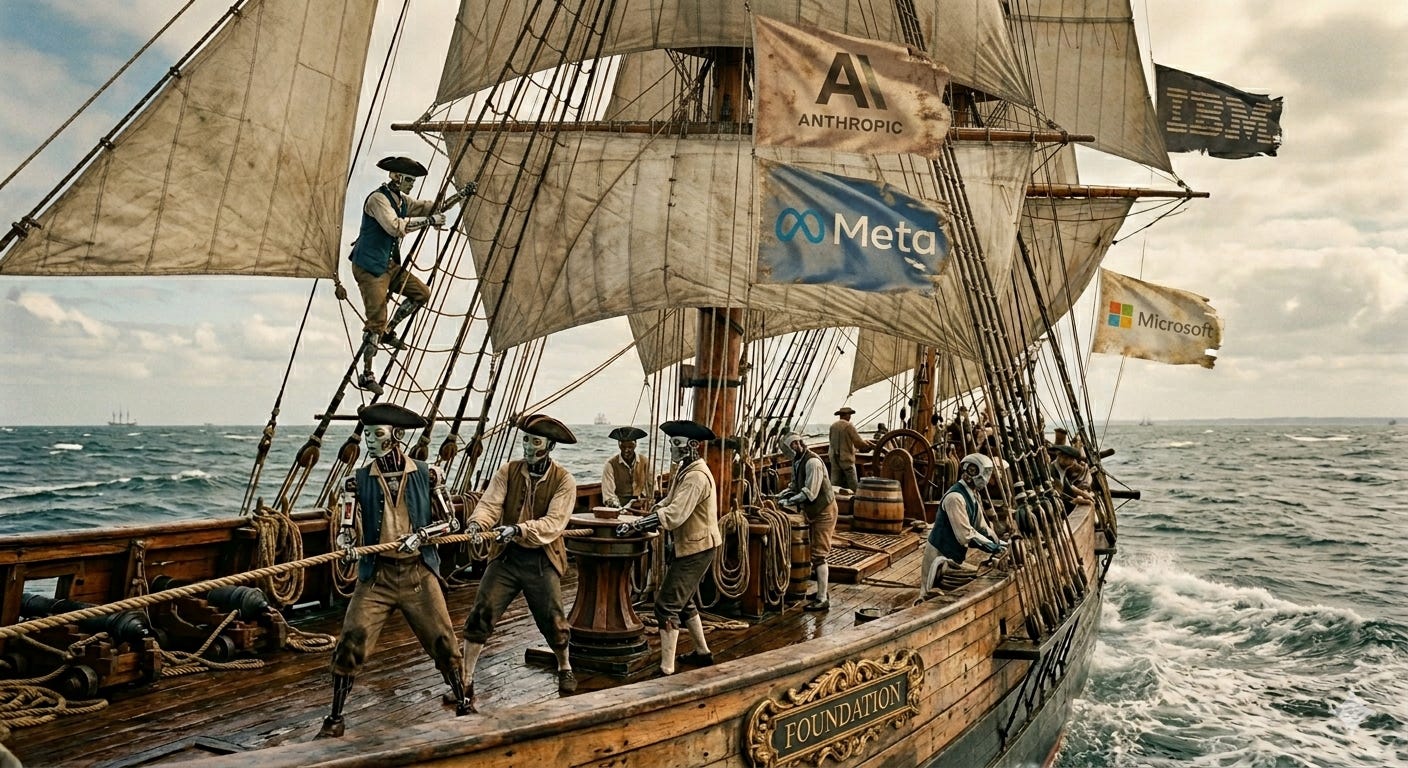
SAIL is an active cross-license, where members cannot enforce against other members for infringing their AI foundation model patents. It acts as a non-aggression pact among active operating companies, but does include some protections in case an asset is transferred to, e.g., a patent assertion entity (PAE).
As of late April, members include Anthropic, Block, eBay, Figma, Genentech, IBM, Meta, Microsoft, and TD Bank Group.
To help IP strategists and counsel navigate the nuanced scope, asymmetrical withdrawal penalties, and hidden strategic risks of this agreement, here is an FAQ detailing what joining SAIL means for most companies and their patent portfolios.
Disclaimer: this is an academic discussion, based on hypothetical scenarios, and not intended to be legal or business advice.

SAIL Foundation & Membership Basics
Q: What is the SAIL Foundation?
A: The SAIL Foundation is “the first organization dedicated to safeguarding AI innovation through a collaborative patent network” (p. 1). It “creates a collaborative licensing zone for the development of AI foundation models” to clear the way for rapid AI development (p. 1).
Q: Who are the members of SAIL?
A: The initiative is led by “founding board members Anthropic, Genentech (a member of the Roche Group), IBM, Meta, and Microsoft, and board observers eBay and TD Bank Group” (p. 1). Additionally, “Block and Figma have also joined as members” (p. 1).
Q: How much does it cost to join?
A: The dues are “$25,000/year (established company rate, discounts available for smaller companies” (p. 15). Failure to pay these fees “within sixty (60) days will result in termination of Membership” (p. 6).
Scope of the License
Q: What exact rights am I granting and receiving by signing this agreement?
A: Each member grants every other member a “worldwide, royalty-free, non-exclusive, non-sublicensable, and non-transferable license… under the Licensed Patents to make, have made, use, import, sell, offer for sale, lease, or otherwise distribute or provide Covered AI Technologies” (p. 1).
Q: Does this mean I am getting a license to every patent owned by companies like Microsoft and Meta?
A: No. You are only getting a license to their “Licensed Patents,” which the agreement strictly defines as the subset of patents that “would, in the absence of a license, be infringed by making, having made, using, importing, selling, offering for sale, leasing, or otherwise distributing or providing Covered AI Technology” (p. 10).
Q: What exactly is defined as a “Covered AI Technology”?
A: Covered AI Technologies include “(a) any Foundation Model; and (b) any software and services specifically designed or substantially modified to primarily serve the purpose of (i) training, fine-tuning, or adaptation of Foundation Models; (ii) testing, verification, validation, or monitoring of Foundation Models… (iii) integrating and/or interoperating with a Foundation Model… or (iv) implementing or enhancing safety mechanisms, capability controls, or oversight” (p. 8).
Q: I build end-user apps powered by AI. Is my application covered by this license?
A: No. The agreement explicitly states that “Covered AI Technologies exclude (x) software products and services built on Foundation Models, including but not limited to end user applications… and (y) hardware infrastructure” (pp. 8, 9).
Q: Does this agreement give me the right to use other members’ proprietary code or trade secrets?
A: No. The agreement contains a strict reservation of rights: “Except as expressly set forth in Sections 1 and 2 no license or right under any Patents or other intellectual property is granted by this Agreement, whether by implication, estoppel, or otherwise” (p. 1).
Risks, Terminations, & Suspensions
Q: What happens if I have already infringed on a member’s AI patent in the past?
A: The agreement grants a backward-looking “release of any and all claims, liabilities, and damages… for all infringement of Licensed Patents to the extent such claims are based on a Licensee’s Covered AI Technology and acts prior to the Effective Date” (p. 1).
Q: Under what circumstances can my license be suspended by another member?
A: A licensor can invoke a defensive suspension if you file “one or more patent infringement claims… against the Licensor or its Affiliates that are based on Licensor’s distribution or use of Covered AI Technologies” (p. 3). You can also be suspended if you initiate “a proceeding challenging the validity, patentability or enforceability of a Licensed Patent” (p. 3).
Q: If I join the SAIL Foundation and later decide to leave, do I get to keep my licenses?
A: Generally, no. The inbound “Licenses granted to a Foundation Member or its Affiliate… shall terminate effective as of the Exit Date” (p. 4). However, there is an asymmetrical penalty for leaving: your outbound patents “shall remain Licensed Patents and will remain and continue to be licensed… following the Exit Date to all Licensees existing as of the Exit Date” (p. 4). The only exception is if you have paid annual fees for at least three years, in which case you retain rights to patents with a priority date prior to your withdrawal (p. 4).
Comparisons to Other Patent Organizations
Q: Is SAIL like the LOT Network, OIN, RPX, Via Licensing, or Unified Patents?
A: While they all seek to reduce patent friction, their mechanisms are distinct.
Unlike LOT Network: LOT is a defensive pact that only triggers if a patent is sold to a troll. SAIL is an active cross-license where members immediately grant “present, fully vested and irrevocable” licenses to each other for AI foundation models (p. 1).
Unlike RPX & Unified Patents: RPX buys patents off the open market, and Unified Patents litigates to invalidate patents owned by companies asserting those assets (alleged “trolls”). SAIL does neither; it is purely a “collaborative patent network” and “shared patent commons” where operating companies pool their own IP (p. 1).
Unlike Via Licensing: Via creates royalty-bearing patent pools to make money. SAIL is explicitly a “royalty-free” licensing pool designed to create a safe zone for development, not to generate licensing revenues (p. 1).
Like the Open Invention Network: SAIL is essentially adopting OIN’s playbook, but applying it to AI instead of open-source software. Both are technology-specific cross-licenses. Members grant royalty-free, non-exclusive licenses to one another. Just as OIN defines a specific “Linux System” boundary for its license, SAIL draws a strict boundary around “Covered AI Technologies”. While OIN is generally free to join and does not permanently encumber patents if you leave, SAIL requires annual dues (e.g., $25,000/year) and features an asymmetrical withdrawal clause—if you leave SAIL, you lose your inbound protection but your previously granted outbound licenses remain in effect permanently (similar to LOT, but only applicable to specific subject matter).
Organizational Structure & Operations
Q: How is Jamster Capital involved?
A: Jamster Capital LLC is a boutique advisory firm that provides consulting and transaction services focused on intellectual property, founded by John Amster. Amster previously co-founded and led RPX Corporation to an $850 million IPO and served as CEO of Rowan Patents. Jamster Capital is not a member granting licenses, but rather the administrative operator. They have been “engaged by the Board of Directors to run the day-to-day operations of the Foundation, including member outreach, governance, marketing/communications, licensing guidance and accounting” (p. 2).
Q: What if the SAIL Foundation dissolves or goes bankrupt?
A: The licenses granted between members are “present, fully vested and irrevocable” and are intended to “run with the Licensed Patents to which they pertain and be binding on subsequent owners and licensees” (p. 1). Furthermore, if a licensor goes bankrupt, the agreement is treated as an executory contract under Section 365(n) of the U.S. Bankruptcy Code, allowing the licensee “to retain its license rights under this Agreement” (p. 6).
Q: Is this massive patent pool an antitrust issue?
A: The agreement includes standard safeguards used by pro-competitive patent pools to avoid antitrust scrutiny. Specifically, the licenses granted are “non-exclusive” (p. 1). Furthermore, members agree that this agreement “does not reflect a royalty that any Foundation Member or its Affiliate might otherwise have negotiated,” preventing it from being used as a price-fixing tool in outside disputes (p. 5).
Strategic Value for Potential Licensees
Q: Do I have to own a certain number of patents to join?
A: No. There is no minimum patent requirement mentioned in the agreement. You are required to grant a license to “each of its Subject Patents,” meaning whatever patents you do own, even if that number is currently zero (p. 1).
Q: How should I know if joining this will help my company?
A: This likely hinges on your company’s core business model and patent portfolio.
It helps you if: You are building, training, or fine-tuning foundation models and need “freedom of action… to confidently invest” without fear of being sued by the massive portfolios of tech giants like Meta, IBM, or Microsoft (p. 1).
Example: Imagine you are a well-funded startup training a new multimodal foundation model from scratch. Doing so might inadvertently infringe on fundamental model-training patents held by Microsoft or IBM. By paying the annual fee and joining SAIL, you instantly receive a royalty-free license to those patents for the purpose of training your model (p. 1). It acts as a relatively cheap, incredibly powerful insurance policy.
It may hurt you if: You are an AI research firm that plans to monetize your own AI patents by asserting them against competitors or charging royalties, because the agreement requires you to grant a “royalty-free” license to all other members (p. 1). Furthermore, if you only build end-user applications on top of models, your core products are excluded from the license’s protection (pp. 8, 9).
Example: Imagine your company builds an AI-powered CRM application (an end-user app) and you happen to own a highly valuable patent on a specific method for fine-tuning LLMs. If you join SAIL, you are forced to give Meta, IBM, and Anthropic a free license to use your fine-tuning patent (p. 1). However, because your actual product is just an end-user application built on top of a model, your CRM product is completely excluded from SAIL’s protective umbrella (pp. 8, 9). You might give away your crown-jewel IP for free and get essentially zero defensive value in return.
Disputes & Enforcement
Q: Are there any provisions about disputes between members or covered patents and where they must take place? Who determines if the patent is covered?
A: Yes, the agreement includes a strict forum selection and governing law clause. Any action or proceeding arising out of or relating to the agreement “shall be brought exclusively in the state or federal courts located in the State of Delaware,” and members irrevocably submit to that jurisdiction (p. 7). Furthermore, the agreement is interpreted and enforced strictly under Delaware law, without reference to choice of law principles (p. 7).
Regarding who determines if a patent is covered, the agreement does not establish an internal arbitration panel or technical tribunal. It also does not grant the Foundation Administrator the authority to adjudicate patent scope (p. 9). The Foundation Administrator’s role is strictly administrative, limited to publishing notices, handling withdrawals, and managing the Foundation Website (p. 9).
Because there is no mandatory arbitration for technical disputes, if two members disagree on whether a specific patent reads onto a “Covered AI Technology”—and thus qualifies as a “Licensed Patent” (p. 10)—that highly technical determination will ultimately have to be litigated and decided by a judge or jury in a Delaware court (p. 7).
Timing & Strategic Entry
Q: Since the agreement absolves past infringement, shouldn’t I just wait until a member threatens comes a-knockin’ before paying to join?
A: While it is true that the agreement grants a “release of any and all claims, liabilities, and damages… for all infringement of Licensed Patents… prior to the Effective Date” (p. 1), waiting on the sidelines is a highly dangerous strategy for two key reasons:
The Patent Transfer Vulnerability: The press release explicitly warns that “Inevitably, some assets will fall into the hands of assertion entities who will enforce them” (p. 2). If a SAIL member sells a patent to a non-member (like a patent troll) before you join, you cannot get a license to that patent through SAIL. However, if you join before the patent is sold, the agreement dictates that all licenses “run with the Licensed Patents” (p. 1) and any transfer “shall be subject to the Licenses” (pp. 1-2). Joining early locks in your protection; waiting leaves you exposed to third-party buyers.
Freedom to Operate and Due Diligence: Operating under the silent threat of litigation means you lack the “freedom of action… to confidently invest in technologies” (p. 1). If you are seeking venture funding or looking to be acquired, sophisticated investors will identify your unprotected use of foundation models during IP due diligence. That uncertainty can severely impact your valuation or kill a deal entirely long before a SAIL member ever officially “comes knocking.”
Example: Imagine Meta decides to prune its massive AI portfolio and sells 50 older foundation model patents to an aggressive patent troll. If you had already paid your $25,000 and joined SAIL, your license to those 50 patents is fully vested and travels with the patents (p. 1). When the troll comes knocking, you simply show them your license and they go away. However, if you were waiting on the sidelines, you are out of luck. Because the troll is not a SAIL member, you cannot join SAIL to get a retroactive release against them. You tried to save $25,000 (per year) and now you are facing millions of dollars in federal litigation costs and damages.
Considerations for Patent Buyers & Assertion Entities
Q: What should I consider if I’m a PAE interested in acquiring AI-related patents from a member company?
A: As a PAE, your entire business model relies on the ability to enforce patents against operating companies. The press release acknowledges that “inevitably, some assets will fall into the hands of assertion entities who will enforce them” (Press Release, p. 2). However, buying patents from a SAIL member requires rigorous due diligence, as those assets may come heavily encumbered.
Here are the critical factors you must consider before acquiring an AI patent from a SAIL member:
The “Run with the Patent” Encumbrance: You are not buying a clean asset. The agreement dictates that all licenses granted “are intended to and shall run with the Licensed Patents to which they pertain and be binding on subsequent owners and licensees” (License, p. 1). This means the patent remains permanently licensed to every company that was a SAIL member at the time of the transfer.
Mandatory Acceptance of Terms: You cannot simply buy the patent and ignore the SAIL encumbrance. The agreement legally binds the seller to ensure that “any transferee shall agree that the transfer is subject to Licenses granted in this Agreement” (License, p. 2).
The “Covered AI Technology” Subject Matter Check: Before you finalize the acquisition, you must carefully map the claims of the patent to the agreement’s definitions. A patent only becomes an encumbered “Licensed Patent” if it would be infringed by making, using, or distributing “Covered AI Technology” (License, p. 10). If the patent specifically claims the architecture or training of a “Foundation Model” (License, p. 8), it is encumbered. However, if the patent’s claims are limited to “end user applications” (License, pp. 8-9) or “hardware infrastructure” (License, p. 9), those are explicitly excluded from the license scope, meaning you could still freely assert those specific claims against SAIL members.
Severely Reduced Target Landscape: Because the license runs with the covered patent, you will be completely barred from asserting that patent against any current SAIL Foundation member for their use of “Covered AI Technologies.” Your addressable market for litigation or licensing demands on those specific claims is instantly reduced to non-members.
Example: Imagine you are a PAE evaluating a portfolio of 10 AI patents owned by Meta (a founding SAIL member). If you purchase those patents, you might plan to monetize them by suing IBM, Microsoft, and Anthropic. During due diligence, you must check the claims. If 8 of those patents cover core foundation model training techniques (License, p. 8), they are encumbered by a “present, fully vested and irrevocable” license to those SAIL members (License, p. 1). You cannot sue IBM or Microsoft for using those 8 patents.
However, if the remaining 2 patents exclusively cover AI hardware configurations (License, p. 9), those are not “Covered AI Technologies.” You could acquire those 2 patents and successfully assert them against Microsoft and IBM, because SAIL does not grant them a license for hardware.
Q: If I buy a disputably covered patent from a member, am I stuck enforcing it in Delaware?
A: If you are trying to enforce it against a current SAIL Foundation member, almost certainly yes. While a patent buyer or Patent Assertion Entity (PAE) might strongly prefer to file an infringement lawsuit in a traditionally patent-friendly jurisdiction (like the Eastern or Western Districts of Texas), the SAIL agreement heavily complicates your choice of venue.
When you acquire a patent from a member, the agreement legally binds the seller to ensure that “any transferee shall agree that the transfer is subject to Licenses granted in this Agreement” (p. 2). If you sue a SAIL member in Texas and they raise the defense that the patent’s subject matter is covered by the SAIL license, that specific dispute inherently requires interpreting the agreement.
The agreement explicitly mandates that “[a]ny action or proceeding arising out of or relating to this Agreement shall be brought exclusively in the state or federal courts located in the State of Delaware” (p. 7). Therefore, the defending member will almost certainly leverage this clause to successfully transfer the case to Delaware, or they will preemptively file a Declaratory Judgment action against you in Delaware to have a judge rule on whether the patent is covered.
Strategic Exception: If you are enforcing that exact same acquired patent against a non-member, the SAIL agreement’s defensive licenses—and thereby its Delaware forum selection clause—do not apply to that specific dispute. In that scenario, you are free to file the lawsuit wherever standard federal venue laws allow.
Final Thoughts
Ultimately, joining the SAIL Foundation is a calculated trade-off between sacrificing potential licensing revenue and securing an essential defensive shield within the rapidly evolving AI landscape.
While the asymmetrical exit penalties and loss of assertion rights against fellow members pose significant long-term constraints, these risks must be weighed against the immediate protection from predatory patent transfers and costly litigation.
For companies prioritizing rapid innovation over patent monetization, SAIL offers a powerful insurance policy, provided you’re willing to play in a shared sandbox where the fences are high and the exits are steep.
Disclaimer: This is an academic discussion, based on hypothetical scenarios, and not intended to be legal or business advice. This is provided for informational purposes only and does not constitute legal or financial advice. To the extent there are any opinions in this article, they are the author’s alone and do not represent the beliefs of his firm or clients. The strategies expressed are purely speculation based on publicly available information. The information expressed is subject to change at any time and should be checked for completeness, accuracy and current applicability. For advice, consult a suitably licensed attorney and/or patent professional.