


On May 1, 2026, the United States Patent and Trademark Office announced a new registration requirement for the Open Data Portal (ODP). Starting June 18, 2026, users must possess a USPTO.gov account to access the platform. The agency states the measure will “improve site security” and limit “costly, unregistered bot traffic” (Announcement, ¶ 3).
For patent practitioners and intellectual property professionals, this represents another systemic shift toward verified, authenticated access to government records.
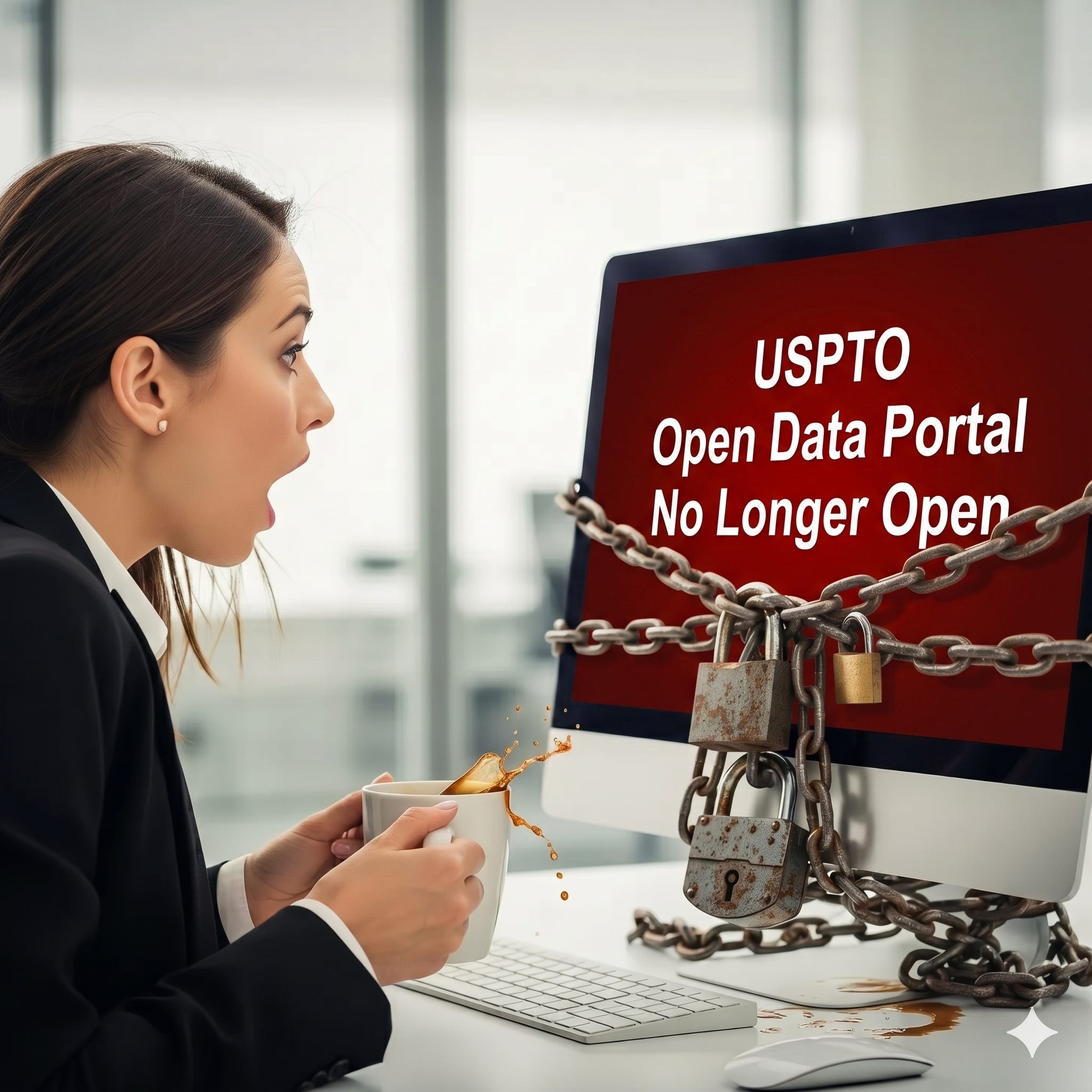
The Open Data Portal has functioned as the unified data platform for the agency since February 2025, providing publicly accessible patent and trademark datasets.
Soon, the front door to this repository will require a digital key.
Closing Another Door to Anonymous Access
Observers of patent office policy may recognize a distinct pattern regarding data access. In September 2025, the agency eliminated guest access to Patent Center. That regulatory update required users to authenticate via ID.me or a paper verification form to view prosecution histories.
The policy disturbed the workflows for many firms and IP stakeholders, forcing support staff, in-house counsel, and foreign associates to adopt new verification procedures. Following that restriction, practitioners heavily utilized the Open Data Portal as an alternative method to view public file histories without complex login procedures.
A September 2025 blog post highlighted Global Dossier and the Open Data Portal web interface as the two remaining avenues for anonymous file wrappers. The impending June 2026 update removes the ODP from that short list of anonymous channels.
The agency previously implemented interface modifications to block automated actions. In April 2026, the USPTO restricted sponsored support staff from inserting practitioner signatures on the Web Application Data Sheet.
That procedural barrier appeared specifically formulated to throttle the volume of machine-generated filings. The current ODP policy aligns directly with these prior actions. Patent administrators are actively creating an environment where the agency can monitor and control the flow of intellectual property data into and out of its servers.
Targeting Automated Scrapers and AI Data Mining
The explicit targeting of unregistered traffic suggests the USPTO aims to minimize misuse of the portal by automated systems and scrapers. Large language models, such as Claude and other generative artificial intelligence systems, require massive datasets for training and operation.
Patent records feature highly technical, standardized language, making them highly desirable for machine learning developers. Unrestricted access permits automated programs to extract millions of documents, which apparently can stress government infrastructure.
The USPTO notes that mandatory sign-ins will “[b]lock harmful automated bot traffic that can slow or disrupt the site” and “[r]educe infrastructure costs” (FAQ, ¶ 14). By placing the data behind a registration wall (or API key), the agency can identify and potentially restrict users extracting bulk data for AI training without authorization.
The FAQ explicitly warns developers about API rate limits, noting that users exceeding their weekly download quota “will receive an HTTP 429 error” and must “wait seven days from the time you first started using the API key to try again” (FAQ, ¶ 73). These mechanical throttles demonstrate a clear intent to slow down machine-speed extraction.
New Profiles Coming
The agency explicitly connects this registration mandate to gathering more granular data on its users, noting the requirement “will allow the agency to improve the customer profile and future offerings” (Announcement, ¶ 3).
The administration plans to expand this data collection soon, stating they expect “to send a request for more profile information late this summer to improve existing customer profiles” (Announcement, ¶ 4). Patent practitioners and IP stakeholders might view this data gathering cautiously.
Detailed profiling establishes a framework for the granular monitoring of research habits. Sorting users into specific categories—such as law firm, academic institution, or commercial data broker—could provides the administrative architecture necessary to implement tiered access, restrict specific demographic groups, or introduce commercial usage fees at a later date.
Technical Shifts: The End of XML and Legacy Platforms
Practitioners adjusting to the June 18 deadline should evaluate their data extraction methods. The Developer Hub (DH) will retire entirely on May 29, 2026 (FAQ).
All public data from the DH has migrated to the ODP. Users currently accessing Application Programming Interfaces (APIs) will continue using their accounts, but obtaining a new API key requires strict ID.me verification. The FAQ specifies that “[i]n order to get access to an API you must get your USPTO.gov account verified with ID.me to receive an API key” (FAQ, ¶ 16).
The consolidation of legacy platforms into the ODP makes compliance unavoidable. The portal now houses data previously distributed across multiple systems. The FAQ lists the inclusion of Patent Trial and Appeal Board (PTAB) proceeding data, Patent File Wrapper (PFW) datasets previously found in the Patent Examination Data System (PEDS), Final Petitions Decisions (FPD), and the Bulk Data Storage System (BDSS) (FAQ, ¶ 6). The Bulk Data Storage System webpage “has been retired,” forcing users to access bulk files through the ODP’s directory feature (FAQ, ¶ 35).
The transition away from legacy systems shows a shift in data handling. Many patent professionals relied on the Patent Examination Data System to download the entire USPTO dataset in flat, static XML files. The agency has discontinued this practice. The FAQ confirms that data will no longer be available in XML files and specifies that users must now access this information programmatically in JSON format via the API (FAQ, ¶ 62). This technical shift requires developers to rewrite their data ingestion pipelines entirely. Software tools built to parse XML bulk downloads will break unless updated to handle the new JSON API endpoints.
In addition to formatting changes, the search parameters have been modified. The new interface allows users to conduct Boolean queries across several attributes from one search bar and customize the data attributes they wish to view (FAQ, ¶ 40).
For practitioners accustomed to the old systems, these changes require dedicated retraining time. The agency affirms that an API key is assigned “by person, not organization” and rejects requests for company-wide API keys (FAQ, ¶ 81). This policy forces every individual developer or data scientist within a legal technology company to undergo personal identity verification.
Benefits
Requiring registration for ODP access provides measurable advantages for system stability. Unregistered bot traffic consumes significant server bandwidth. By forcing users to log in, the USPTO can allocate resources more effectively, maintaining a platform that remains safe, fast, and reliable.
Verified accounts allow administrators to track usage patterns and prevent malicious actors from degrading site performance. For regular practitioners, this may result in faster load times and fewer system outages during critical research tasks.
The consolidation of data into a single, modernized platform improves the quality of the information extracted. The USPTO confirms that the data is preprocessed and analyzed, confirming schema consistency (FAQ, ¶ 46). Users extracting Patent File Wrapper data can now download specific JSON responses rather than downloading massive, static XML files to find a single record.
Challenges
The updated policy introduces administrative friction for IP professionals and support staff. Law firms must verify all personnel requiring public patent data have active, registered USPTO.gov accounts. Foreign associates and independent researchers face additional steps to view formerly public records. Consolidating datasets into the ODP means users cannot easily circumvent the login requirement by visiting legacy platforms like the Bulk Data Storage System. Every inquiry requires authentication.
The prohibition on shared organizational API keys creates logistical hurdles for corporate legal departments and patent analytics companies. If a developer leaves an organization, their ID.me-linked API key cannot be reassigned (FAQ, ¶ 79). Firms and companies must direct new employees to create and verify new personal API keys, potentially slowing down onboarding processes for technical staff.
Risks
Restricting access to public data carries systemic vulnerabilities. The patent system operates on the principle of public disclosure in exchange for exclusive rights. Placing the entire repository of bulk patent data behind a registration requirement may create a barrier for independent inventors, journalists, and academic researchers.
The agency states that ODP provides access to data “made available to the public as set forth in 37 CFR 1.11 and 1.14” (FAQ, ¶ 5). Yet, adding mandatory registration limits immediate transparency.
Developers relying on ODP APIs face the stringent ID.me verification process. If the verification systems experience downtime, third-party commercial patent software reliant on USPTO APIs could suffer catastrophic failures, leaving patent attorneys without necessary analytics tools. The reliance on a third-party identity verification service introduces a point of failure outside the direct control of the patent office.
The agency risks penalizing legitimate automated research in its pursuit of harmful bot traffic. Academic institutions utilizing algorithms to study patent trends may trigger the HTTP 429 error rate limits, delaying valuable economic and legal research.
By treating all automated extraction with suspicion, the agency may slow the development of legitimate, helpful AI tools built to assist practitioners.
Conclusion
The USPTO decision to mandate registration for the Open Data Portal marks a definitive end to anonymous bulk data extraction. The administration is actively constructing digital barriers to manage the heavy demands of automated AI scrapers like new versions Claude and ChatGPT.
Patent practitioners, data developers, and IP stakeholders must adapt their research workflows to accommodate these new verification standards prior to the June 18 deadline. The agency continues to prioritize system security and resource management over unfettered, anonymous public access.
For routine file wrapper inspection, Global Dossier stands as the final public portal offering anonymous access. The Global Dossier system operates as a collaborative IP5 initiative rather than an exclusive USPTO property. The platform escapes the immediate reach of the June 2026 login mandate.
Patent professionals can continue using the interface for single-document retrievals of post-2003 applications. Placing heavy reliance on Global Dossier carries strategic risks. The system lacks bulk download capabilities and offers no programmable API for automated extraction.
If data scrapers redirect their traffic toward Global Dossier following the ODP registration deadline, the participating international offices might implement parallel authentication barriers to protect their shared infrastructure.
The patent community should prepare for a scenario where easy, anonymous access to official patent records ceases to exist—and eventually requires a subscription.
Disclaimer: This is provided for informational purposes only and does not constitute legal or financial advice. To the extent there are any opinions in this article, they are the author’s alone and do not represent the beliefs of his firm or clients. The strategies expressed are purely speculation based on publicly available information. The information expressed is subject to change at any time and should be checked for completeness, accuracy and current applicability. For advice, consult a suitably licensed attorney and/or patent professional.