


On March 25, 2026, United States Patent and Trademark Office Director John A. Squires presented a detailed operational framework to the House Judiciary Subcommittee on Courts, Intellectual Property, Artificial Intelligence, and the Internet.
Testifying as the head of the agency, Squires provided a comprehensive update on technology deployments, backlog reductions, and statutory interpretation under the current administration.
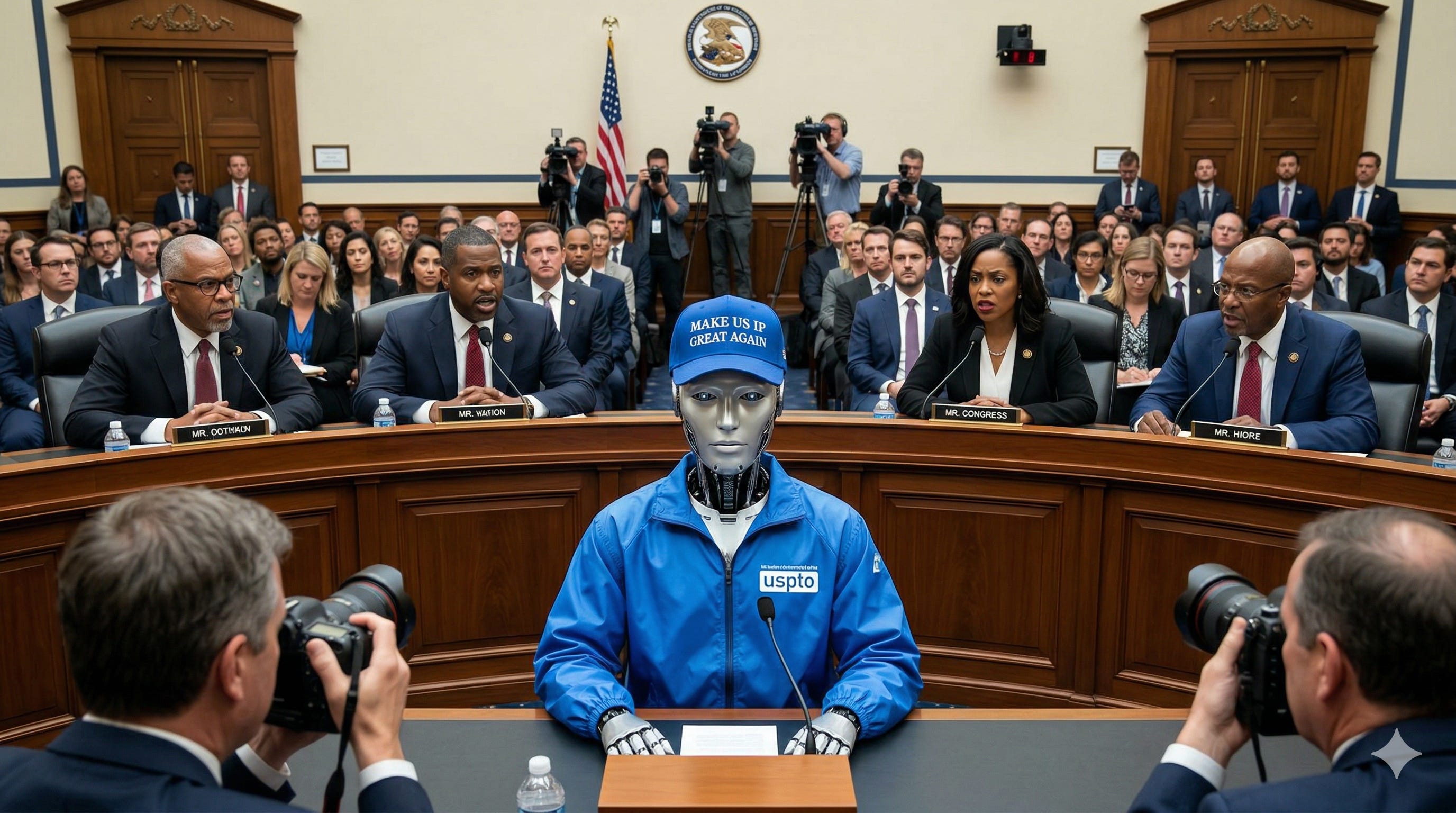
The testimony offered specific insights for intellectual property professionals tracking administrative priorities and preparing for procedural shifts in patent prosecution and trademark registration.
The Economic Foundation of Intellectual Property
Squires conceptualized the USPTO as the Department of Commerce’s “Central Bank of Innovation” (Opening Statement, ¶ 7). The testimony framed intellectual property units as foundational elements flowing into the broader economy.
Squires observed that “every unit of intellectual property we put into circulation is a potential job, a new business, a competitive advantage, an investible asset, a life-saving drug, all flowing into the real economy” (¶ 7).
This economic characterization signals an administrative focus on the commercialization and monetization of patents and trademarks. Treating intellectual property as a tangible economic driver rather than a purely abstract legal right indicates a policy environment favoring strong patent enforcement.
Squires stated that such innovation leads to “national prowess and global reach” (¶ 7), linking domestic intellectual property policy directly to international economic standing.
Patent attorneys and in-house counsel interpreting this rhetoric can anticipate an administration likely to favor agency rules that support patent validity and enforceability in commercial contexts.
Constitutional Frameworks and Global Positioning
The congressional hearing highlighted a distinct ideological approach, prioritizing domestic interests through an explicit “America First IP” agenda (¶ 14). Squires drew a direct line from the Founders’ constitutional inclusion of intellectual property protection to current global competitiveness. He recounted a recent exchange with the head of the United Kingdom’s Intellectual Property Office regarding the adaptability of the United States framework to emerging technologies.
According to Squires, the United States constitutional framework permits the USPTO to readily adapt to emerging fields such as artificial intelligence and quantum computing (¶ 12), prompting the United Kingdom official to remark, “I know – wish I had that” (¶ 13).
Squires utilized this exchange to contrast the United States with foreign administrative systems, stating, “two democracies, two outcomes, but only one clearly atop the IP world today” (¶ 14).
This posture suggests the agency will aggressively pursue administrative policies that maintain a competitive distance from the European Patent Office and other international bodies, potentially by offering more favorable patentability standards for emerging technologies.
Integration of Artificial Intelligence Systems
A substantial portion of the hearing addressed the integration of artificial intelligence within USPTO operations. Patent practitioners and trademark attorneys should anticipate altered timelines and examination procedures based on the implementation of these specific technologies.
In the trademark division, Squires announced the deployment of an “agentic-AI Trademark Classification tool” (¶ 18). The administrative efficiency gains reported are highly significant. According to the Director, processes that previously required “Five months of manual searching, is now a FIVE-SECOND outcome” (¶ 18).
For trademark attorneys, this suggests a near-immediate processing of classification data, which could drastically compress the timeline between filing a trademark application and receiving an initial procedural review.
For patent prosecution, the agency has integrated an “AI search-assistant” designed to provide patent examiners with “a top ten list of prior art – before the first office action” (¶ 19). Squires asserted this would create “quicker pathways to allowance” (¶ 19). Providing examiners with an automated, curated list of prior art fundamentally alters the traditional search strategy, shifting the initial burden of reference discovery from human manual boolean searches to algorithmic retrieval.
Automated systems are actively identifying fraudulent submissions. Squires reported that “AI fraud detections helped us purge 70,000+ baseless filings – in just under a year” (¶ 20).
The testimony characterized these automated systems not as replacements for human personnel, but as tools intended to “become our Examiner’s super-powers, supplying them with a cadre of agents to deploy as they see fit” (¶ 21).
Backlog Reduction and Administrative Funding
Administrative delays consistently impact applicants and practitioners attempting to secure financing or enforce rights. Squires stated that the agency’s primary administrative focus was “slashing the unacceptable backlog by 50,000” (¶ 15). The Director committed to reducing the backlog by “Another 100,000 to come this year” (¶ 16).
This reduction strategy is tied directly to the agency’s fee-setting authority. Squires expressed confidence that by the end of his tenure, “choking backlogs will be a thing of the past, and improved quality – a confidence-indicator” (¶ 17).
He noted that the agency’s operations rely heavily on the “fee authority so thoughtfully provided by Congress, allowing us to operate like a business, maintain long-term financial stability, and achieve our statutory mission” (¶ 9).
Practitioners should monitor upcoming fee schedules, as aggressive technology deployments and backlog reduction efforts typically require sustained capital expenditure funded by increased applicant fees.
Statutory Interpretation and Policy Adjustments
Squires indicated impending shifts regarding statutory interpretation, specifically referencing the Leahy-Smith America Invents Act. The Director noted that “Congress affords us discretion, and our north star to its exercise is always both the letter and the spirit of the AIA” (¶ 22).
The testimony outlined a dual approach to policy adjustments, focusing on pre-grant examination and post-grant proceedings. Squires stated, “We are restoring balance and fairness on both the front-end – with eligibility determinations – and the back end as to trials and error correction – with new feedback loops in between” (¶ 23).
This explicit mention of “eligibility determinations” signals a deliberate effort to alter how 35 U.S.C. § 101 guidelines are applied by examiners. It suggests the USPTO may issue new guidance directing examiners to apply a more permissive standard for software and diagnostic method patents.
Concurrently, modifications to Patent Trial and Appeal Board procedures appear imminent. Framing PTAB trials as “error correction” mechanisms (¶ 23) often correlates with policies intended to limit the institution of Inter Partes Reviews, providing more certainty to patent owners after issuance.
Thoughts and Considerations
Evaluating the March 25 hearing requires a pragmatic assessment of the USPTO’s trajectory. The aggressive adoption of artificial intelligence within administrative procedures presents specific operational benefits, alongside distinct institutional vulnerabilities that IP professionals must monitor.
The primary benefit lies in operational efficiency and prosecution speed. Reducing trademark classification searches from months to seconds (¶ 18) allows brand owners to secure market positioning much faster. In patent prosecution, if the “AI search-assistant” accurately identifies highly relevant prior art “before the first office action” (¶ 19), patent applicants might experience fewer overall office actions.
Reaching a final disposition quickly reduces prosecution costs and allows inventors to commercialize their assets sooner. Purging over 70,000 fraudulent filings (¶ 20) protects the integrity of the federal register, preventing malicious actors from cluttering the trademark system and delaying legitimate corporate applications.
Adjusting 35 U.S.C. § 101 guidelines on the “front-end” (¶ 23) offers software and biotechnology innovators clearer, more predictable pathways to obtaining protection. If it works.
There are distinct challenges associated with these technological deployments. Integrating “agentic-AI” (¶ 18) into federal agency operations requires rigorous quality control and continuous auditing. Relying on algorithmic tools for prior art searches introduces questions regarding the scope, training data, and diversity of the underlying databases.
If an AI search assistant consistently prioritizes specific types of references or misinterprets complex technical language, the resulting “top ten list of prior art” (¶ 19) might miss highly relevant, yet unconventional, references.
Managing the promised reduction of “Another 100,000” (¶ 16) backlogged applications requires balancing administrative speed with examination thoroughness. Accelerating examination without adequate human oversight risks lowering the presumption of validity associated with issued patents, potentially leading to more litigation later.
The reliance on automated systems poses specific risks for patent practitioners and IP owners. A heavy dependence on AI for fraud detection could result in false positives, inadvertently flagging legitimate applications and forcing applicants to expend resources defending their filings before the agency.
Regarding PTAB procedures, altering “trials and error correction” mechanisms (¶ 23) creates near-term procedural unpredictability. As the USPTO applies its “discretion” under the AIA (¶ 22), previous administrative precedents at the PTAB may lose their predictive value. Stakeholders face the risk of operating within a transitional period where internal guidelines shift rapidly, demanding continuous adjustments from in-house counsel and patent attorneys concerning their post-grant filing strategies.
The Agency’s Trajectory
The March 2026 testimony from Director Squires outlines a technologically aggressive strategy for the USPTO. Framing the agency as a “Central Bank of Innovation” (¶ 7) highlights a purely economic approach to intellectual property administration.
Incorporating artificial intelligence to target administrative backlogs and fraudulent filings demonstrates a commitment to modifying standard examination procedures. The promised efficiency gains offer significant value to applicants seeking rapid commercialization; IP professionals must prepare for the operational shifts these algorithms will introduce to daily prosecution practice.
Close observation of the forthcoming changes to eligibility determinations and post-grant trial procedures remains a primary requirement for accurately advising inventors and corporate stakeholders.
Disclaimer: This is provided for informational purposes only and does not constitute legal or financial advice. To the extent there are any opinions in this article, they are the author’s alone and do not represent the beliefs of his firm or clients. The strategies expressed are purely speculation based on publicly available information. The information expressed is subject to change at any time and should be checked for completeness, accuracy and current applicability. For advice, consult a suitably licensed attorney and/or patent professional.