


The emergence of Name, Image, and Likeness (NIL) has forever altered the entertainment and sports industries, chiefly with college athletes and social media. For intellectual property professionals, the conversation is rapidly moving beyond simple endorsement deals into complex questions regarding federal property rights, artificial intelligence, and the preservation of identity.
On February 4, the United States Patent and Trademark Office (USPTO) hosted a comprehensive session featuring Under Secretary of Commerce for Intellectual Property John A. Squires and University of Virginia School of Law Professor John F. Duffy to examine these friction points. The video from that webinar is now publicly available.
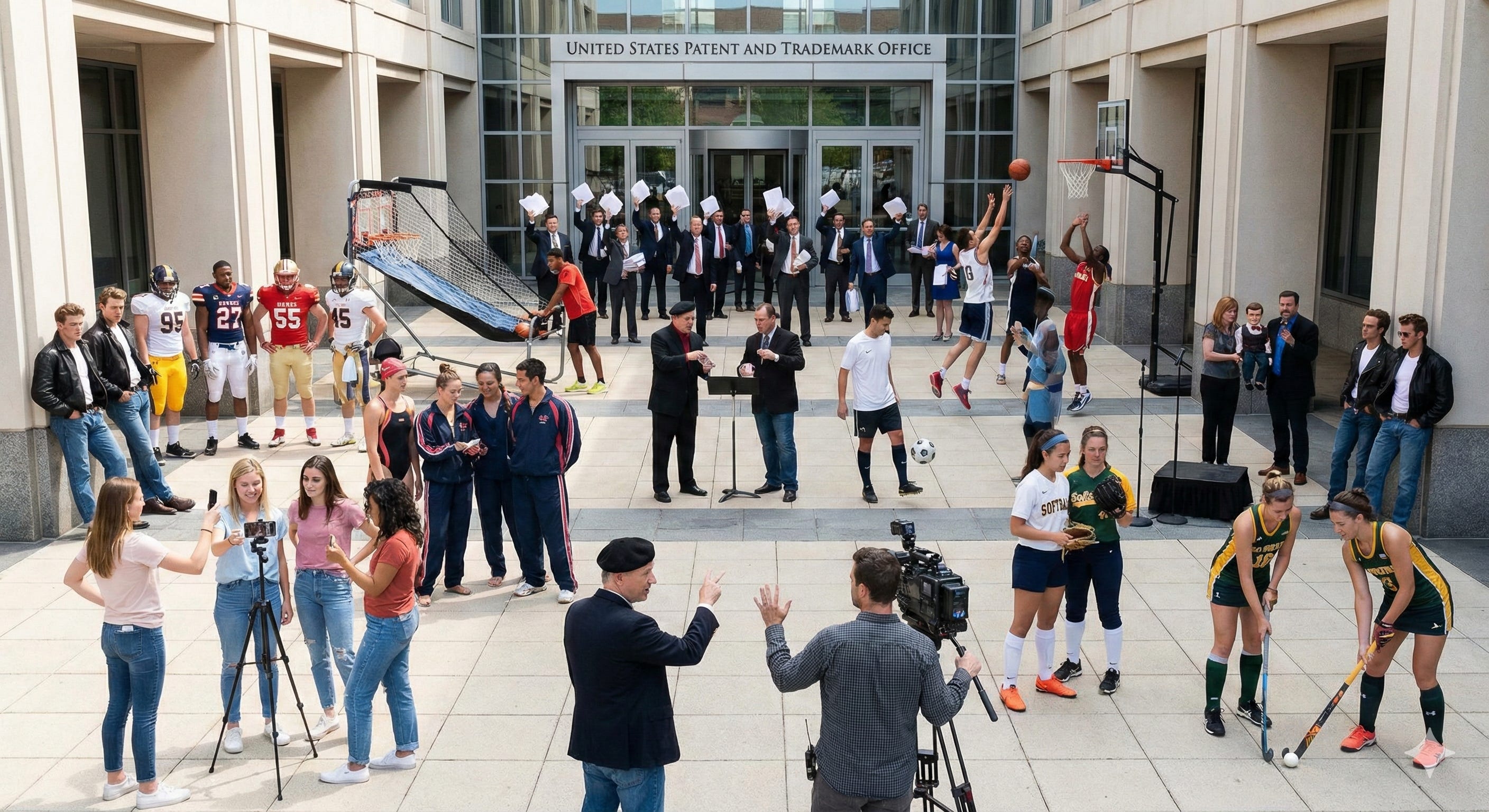
For patent attorneys and in-house counsel, the takeaways from the “USPTO Hour” suggest that while the monetization opportunities are vast, the legal mechanisms for protection remain fragmented. The discussion highlighted a pivot toward using federal trademark registration as a stabilizer in a market historically governed by a patchwork of state publicity laws.
For athletes, entertainers, influencers, and their families, this evolution underscores that brand protection is no longer the exclusive domain of professional superstars, but a critical consideration for anyone looking to secure their identity in an increasingly digital and commercialized landscape.
Beyond the Stadium: A Universal Concern
While the “USPTO Hour” naturally gravitated toward high-profile examples, the panelists made it clear that the need for federal protection extends well beyond household names. The presentation highlighted three distinct categories of creators who must navigate this landscape:
Athletes: Director Squires highlighted the trajectories of NFL quarterbacks Drake Maye and Sam Darnold. Both built enormous brand equity at the collegiate level—long before the current NIL rules were fully established—demonstrating how on-field performance translates directly into protectable intellectual property.
Entertainers: The discussion cited Matthew McConaughey as a prime example of an entertainer proactively using the trademark system. By registering motion marks and catchphrases (discussed below), he is not just merchandising, but creating a legal perimeter against unauthorized AI replications of his persona.
Influencers and “Everyday” Creators: Perhaps most relevant to the wider public was a scenario raised during the Q&A regarding a hypothetical individual who gives advice on sports or movies via Instagram. Liz Jackson, Acting Director of the Northeast Regional Outreach Office, clarified that such “informational services” can indeed constitute commerce. This confirms that one does not necessarily need a shoe deal to warrant federal protection; a substantial digital footprint and a “bona fide intent to use” that identity in commerce are sufficient grounds to seek registration.

The Demsetzian Shift: Why NIL is a Property Right
Professor Duffy provided a theoretical framework for understanding the current explosion of NIL rights, grounding the phenomenon in the economic theories of Harold Demsetz. Demsetz posited that “societies develop property rights when the costs of those rights... begin to be exceeded by, or the benefits begin to exceed those substantial costs.”
Historically, the cost of defining and enforcing publicity rights for the average individual outweighed the benefits. However, the calculation has flipped. The value of personal branding has risen exponentially due to social media and the democratization of fame. Professor Duffy noted that while the costs of granting rights to everyone are not insubstantial, “the value... is becoming much greater, as people really begin to take pride in ownership in their own personal brands.”
This shift is not merely about star athletes. It represents a broader societal change where “everybody [is] going to be famous for 15 minutes,” and consequently, individuals require mechanisms to protect that fame from exploitation.
The AI Catalyst and the “Deepfake” Threat
The urgency to formalize NIL rights is being driven by the rapid advancement of artificial intelligence. Brand owners and IP practitioners must recognize that the threat of AI impersonation is no longer hypothetical. Director Squires characterized AI as “the Roy Kent of breakthrough technologies” because, like the Ted Lasso midfielder, “it’s here, it’s there, it’s every[where].”
The risks posed by deepfakes have caught the attention of legislators. Congress recently passed the “Take It Down Act” to address the non-consensual use of digital likenesses. However, Professor Duffy offered a critical distinction for legal professionals to consider: the Act relies on administrative and criminal penalties rather than establishing a clear property right.
“If there are just administrative rights or criminal rights, you have to go to the government and convince somebody in the government that this is worth their time. If it’s a property right, you can go to court yourself. It’s a civil right.”
This distinction is vital for IP owners and counsel advising clients. A property right offers a private right of action, whereas reliance on criminal statutes leaves enforcement at the discretion of prosecutors. Consequently, sophisticated market actors are looking toward federal trademark registration to fill the gap.
Strategic Federal Registration: A Force Field Against AI
One of the most notable developments discussed was the proactive legal strategy employed by actor Matthew McConaughey. To combat the risk of AI usurpation, McConaughey’s team registered not only his catchphrases but also specific “motion marks.” Director Squires described these registrations as an attempt to “provide effectively a force field against AI usurpation.” Indeed, these efforts proved successful at the trademark office; recently, the USPTO granted McConaughey several federal registrations for these non-traditional marks, establishing a novel precedent for celebrity brand protection.
For trademark attorneys, this signals a creative expansion of what constitutes a protectable mark in the context of human identity. It suggests that static protection of a name may be insufficient in an era of video generation. Registering motion marks or sound marks may be used to create a federal weapon that can be wielded against unauthorized digital replicas.
The Duke University Case: A Warning on Contractual Overreach
The webinar also touched upon the friction between institutions and individuals, highlighted by the recent litigation between Duke University and its quarterback, Darien Mensa. Duke sued Mensa regarding an NIL contract that allegedly granted the university broad rights to his name, image, and likeness.
Director Squires noted that the deal reportedly “promised Mensa millions of dollars over 2 years and gave Duke broad rights to his name, image, and likeness in connection with anything on the gridiron.” When Mensa attempted to transfer, the university argued his exclusive license belonged to them. Although settled, this case serves as a stark warning for athletes and practitioners drafting or reviewing NIL agreements.
The core issue involves the “bundle of rights.” If an athlete or influencer signs away exclusive broad rights, they may inadvertently ruin their “freedom to use their identities” in the future. Parties must scrutinize the scope and transferability of these licenses to ensure that the individual retains control over the core of their personal brand, especially if they change affiliation.
Trademark Nuts and Bolts: Converting Identity to Commerce
While “rights of publicity” protect the person, trademarks protect the source of goods and services. Liz Jackson, Acting Director of the Northeast Regional Outreach Office, clarified the operational steps for converting NIL into a federal trademark. The mere existence of fame does not create trademark rights; there must be a nexus with commerce.
Common classes for athletes and influencers include:
Class 25: Clothing (shirts, pants, hats).
Class 35: Endorsement services and promoting goods of others.
Class 41: Entertainment services and personal appearances.
Jackson emphasized the “likelihood of confusion” test. A trademark application will fail if it is confusingly similar to an existing mark used on related goods. Additionally, she noted that if a mark includes a name or realistic depiction of a living individual, the USPTO requires “signed consent to register.” For minors, this introduces complexities regarding the capacity to contract, potentially requiring parent or guardian intervention depending on state law.
Global Considerations and Harmonization
NIL is not solely an American phenomenon. Professor Duffy pointed out that the market for personal brands is “worldwide,” particularly in sports like track and field or soccer. Influencers on platforms like Instagram cater to a global audience.
Different jurisdictions are experimenting with various models. For instance, Denmark is considering “granting a copyright to every citizen in their name, image, and likeness,” a move Duffy critiqued as potentially “not the greatest way to go” but worthy of discussion. India is also developing frameworks. For IP attorneys, this signals the eventual need for international harmonization, similar to the TRIPS agreement for patents and copyrights. Until then, practitioners should consider international trademark filings (via the Madrid Protocol) for clients with global reach.
Analysis: Benefits, Challenges, and Risks
Before advising NIL clients to rush toward federal registration, legal professionals should weigh the current landscape.
Benefits:
Federal Jurisdiction: Federal registration provides a clear path to federal court, avoiding the vagaries of state common law and diverse right of publicity statutes.
Presumption of Ownership: Registration provides legal presumptions that are valuable in litigation and enforcement against counterfeiters or unauthorized digital copies.
Asset Value: A registered trademark is a transferable, licensable asset that adds tangible value to an individual’s portfolio beyond their physical ability to perform or compete.
Challenges:
Cost and Complexity: Unlike state common law rights which arise automatically, federal registration requires fees, maintenance, and navigation of office actions.
Strict “Use” Requirements: One cannot merely “squat” on a name. There must be a bona fide intent to use the mark in commerce, and eventual proof of use (specimens) is mandatory.
Crowded Fields: As more individuals file for common names or phrases, the likelihood of confusion refusals (Section 2(d)) will increase, requiring sophisticated arguments to overcome.
Risks:
Contractual Encumbrances: As seen in the Duke case, there is a risk that young athletes or creators may sign agreements that license their trademarks too broadly, effectively losing control of their own identity for long periods.
Scams: The public nature of trademark filings makes applicants targets for scammers requesting fees. Practitioners must warn clients that the USPTO never asks for payment via phone or text.
AI Velocity: The law moves slower than technology. While motion marks offer a potential tool, it remains untested whether trademark law can fully contain the proliferation of AI-generated likenesses without specific new property rights legislation.
Conclusion
The “USPTO Hour” underscored that Name, Image, and Likeness has graduated from a niche concern of Hollywood agents to a central pillar of modern intellectual property. Director Squires and Professor Duffy presented a compelling case for the use of federal trademark protection as a stabilizing force in this fluid environment.
Like several other new IP policies from his agency, Director Squires appears to be promoting the USPTO as open for business and eager to grant protection to those willing to fill out the forms, pay the fees, and follow the rules.
For IP practitioners, the task is to guide clients through the transition from passive publicity rights to active, managed trademark portfolios. Moreover, monitoring how brands are combatting AI-based copycatting will likely become the baseline for competent trademark counsel.
As technology continues to blur the lines between reality and simulation, securing these fundamental property rights is a prudent, if not essential, strategy for any individual with a public footprint.
Disclaimer: This is provided for informational purposes only and does not constitute legal or financial advice. To the extent there are any opinions in this article, they are the author’s alone and do not represent the beliefs of his firm or clients. The strategies expressed are purely speculation based on publicly available information. The information expressed is subject to change at any time and should be checked for completeness, accuracy and current applicability. For advice, consult a suitably licensed attorney and/or patent professional.