


The United States Court of Appeals for the Federal Circuit recently issued a precedential opinion clarifying the evidentiary burdens required to establish structural equivalence in means-plus-function patent claims.
In Genuine Enabling Technology LLC v. Sony Group Corporation, No. 2024-1686 (Fed. Cir. Feb. 19, 2026), the appellate court addressed a dispute over the level of detail a patent owner must supply to map an accused product’s functionality to a patent’s corresponding specification structure. The Federal Circuit affirmed the district court’s grant of summary judgment of noninfringement in favor of Sony Group Corporation.
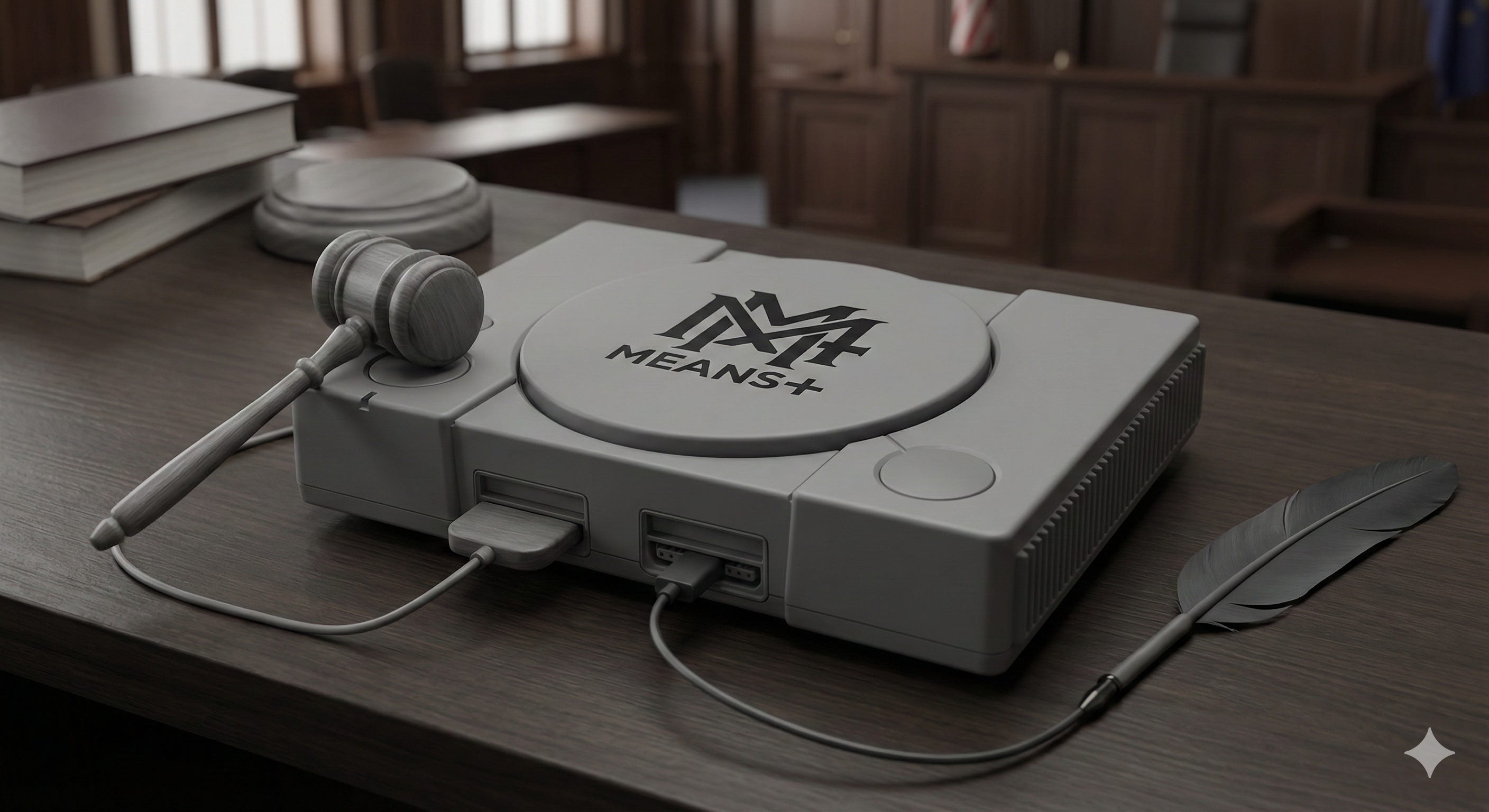
The ruling highlights the strict requirement that expert testimony must account for all elements of a claimed structure or provide a substantive explanation for omitting specific components from the infringement analysis.
Background of the Dispute
The conflict centered around U.S. Patent No. 6,219,730 (the ’730 patent), owned by Genuine Enabling Technology LLC (GET). At the time of the invention, computers required dedicated hardware resources, such as individual ports, for each separate input device like a keyboard or a mouse (Slip Op., p. 2).
This created significant problems related to limited hardware capacity. The ’730 patent proposed a solution: combining data streams from different input devices into a single combined data stream to minimize the number of computer resources required (p. 3). The patent achieves the combination of data streams utilizing a specific component referred to as an “encoding means.”
During litigation at the U.S. District Court for the District of Delaware, GET alleged that Sony infringed the ’730 patent. The allegations targeted Sony’s PlayStation 3 and 4 consoles and their corresponding controllers.
Specifically, GET asserted that the Bluetooth modules inside the PlayStation controllers synchronized user input from controller buttons with input from controller sensors, falling under the patent’s “encoding means” limitation (p. 5).
The district court construed the “encoding means” limitation as a means-plus-function term subject to 35 U.S.C. § 112(f). The court identified the corresponding structure in the ’730 patent’s specification as a detailed logic design circuit labeled “logic block 34” in Figure 4A (p. 6). Logic block 34 contains a multitude of distinct signal paths and components, such as a data selector, a clock generator, and an oscillator.
The specification includes a detailed description of block 34’s multi-step synchronization process (p. 5). The clock generator divides the signal from the oscillator to create a bit-rate clock signal. The clock generator feeds the signal into the codec, which converts the input signal into an input stream. That input stream undergoes further conversion into a digital input stream. The clock generator forms a control signal utilized by the data selector. Using this control signal, the data selector samples bits from the user input stream and the input stream, storing the data in a single output signal to synchronize the two data streams (p. 5).
A procedural misstep severely impacted GET’s ability to prove infringement. The plaintiff waited until the final day of fact discovery to serve subpoenas on Sony’s manufacturing partners to obtain the internal schematics of the accused Bluetooth modules (p. 6). The district court denied requests to extend the discovery period. As a result, GET and its technical expert, Dr. Fernald, formulated an infringement theory without ever reviewing the physical schematic of the accused Bluetooth module.
To bridge the gap between the complex logic block 34 and the unseen internal structure of Sony’s Bluetooth module, Dr. Fernald narrowed his analysis. Initially acknowledging that multiple components within logic block 34 played roles in synchronizing the data streams, Dr. Fernald later altered his position.
During a Daubert hearing, the expert claimed that the “way” the structure operated relied exclusively on synchronizing the streams to a common “bit-rate clock,” disregarding the rest of the logic block 34 circuit entirely (p. 7).
The district court excluded the expert’s final conclusion of structural equivalence, finding the simplified analysis lacked factual support. Summary judgment of noninfringement followed.
The Court’s Analysis
The Federal Circuit faced a specific legal question: Can a patent owner demonstrate structural equivalence under 35 U.S.C. § 112(f) by comparing the accused product to a single component of a multi-component corresponding structure without explaining the omission of the remaining components? The appellate court answered in the negative.
Under established patent law, a means-plus-function limitation recites a function to be performed rather than a definite structure or materials for performing that function (p. 9).
The statute dictates that such a limitation covers the corresponding structure described in the specification and equivalents thereof. The duty of a patentee to clearly link or associate structure with the claimed function acts as the quid pro quo for allowing the patentee to express the claim in terms of function (p. 9).
To clarify the legal standard, the Federal Circuit relied on its established precedent, noting: “Literal infringement of a means-plus-function limitation requires that the relevant structure in the accused device perform the identical function recited in the claim and be identical or equivalent to the corresponding structure in the specification.” Odetics, Inc. v. Storage Tech. Corp., 185 F.3d 1259, 1267 (Fed. Cir. 1999) (p. 9).
The court further explained the mechanics of proving this equivalence: “’Once the relevant structure in the accused device has been identified, a party may prove it is equivalent to the disclosed structure by showing that the two perform the identical function in substantially the same way, with substantially the same result.’” Traxcell Techs., LLC v. Sprint Commc’ns Co., 15 F.4th 1121, 1128 (Fed. Cir. 2021) (p. 9).
This framework constitutes the “function-way-result test” for structural equivalence of a means-plus-function limitation.
The Federal Circuit determined that GET’s infringement analysis failed to satisfy the “way” prong of the equivalence test. The court highlighted that the ’730 patent specification described a multi-step synchronization process involving numerous components within logic block 34. By focusing exclusively on the bit-rate clock and discarding elements like the data selector and codec, the expert failed to account for the full structure disclosed in the patent.
The court drew heavily from Traxcell, where a patentee similarly neglected to address a significant fraction of a detailed algorithm identified in the specification. The Federal Circuit agreed with the lower court that Dr. Fernald provided no substantive explanation justifying the omission of the other elements of logic block 34 for the purposes of synchronization. The shifting testimony—first acknowledging the roles of other components and later ignoring them—further undermined the expert’s credibility on the issue.
The Federal Circuit drew comparisons to its prior decision in Dawn Equipment Co. v. Kentucky Farms Inc., 140 F.3d 1009 (Fed. Cir. 1998). In that matter, the claimed structure consisted of a rotatable shaft, a pin, and a slot. That expert merely compared the pins of the claimed and accused mechanisms without referencing the other structural elements (p. 12). The court observed that comparing isolated components falls short of the legal standard. Applying that case directly to Dr. Fernald’s testimony, the court stated:
“Like the expert’s incomplete, pin-only analysis in Dawn, merely comparing the bit-rate clock of the ‘encoding means’ structure, as GET attempts to do here, is insufficient to demonstrate that the claimed and accused structures are equivalent. See Dawn, 140 F.3d at 1017.” (p. 13)
The court evaluated Dr. Fernald’s attempt to define the “way” the accused Bluetooth module operated as a generic synchronization to a bit-clock.
The Federal Circuit affirmed the district court’s rejection of this theory, noting the expert relied on general inferences rather than specific structural analysis. The opinion states:
“First, we agree with the district court that this testimony is conclusory... a party cannot defeat summary judgment ‘with conclusory allegations, unsupported assertions, or only a scintilla of evidence.’” (p. 15)
The court concluded that allowing such a broad equivalence theory would collapse the function-way-result test into a mere function-result test, directly contradicting established precedent.
Key Takeaways and Practical Implications
The Federal Circuit’s ruling provides strict instructions for patent practitioners handling means-plus-function claims. The decision highlights the demanding evidentiary standard required to survive summary judgment when asserting structural equivalence.
A primary lesson involves expert testimony preparation. Experts mapping an accused product to a means-plus-function structure must perform a comprehensive analysis of the entire corresponding structure disclosed in the specification.
If the expert intends to argue that certain components within the disclosed structure are optional, supplementary, or immaterial to the claimed function, the expert report must contain a detailed, technical justification for that position.
Omitting components from the equivalence analysis without a comprehensive technical defense will render the testimony vulnerable to Daubert challenges and summary judgment motions.
The decision clarifies the boundaries of the rule established in Odetics, which holds that determination of structural equivalence does not mandate a strict component-by-component analysis. The Federal Circuit firmly stated that patentees cannot use this flexibility to submit incomplete infringement theories. The court explained the precise balance required:
The patentee must still account for each element of the claimed structure in its equivalence analysis. See Odetics, 185 F.3d at 1264, 1269–70...
As Odetics and our caselaw demonstrate, each element of the identified structure in the specification does not need its own equivalence mapping to a respective element in the accused product. See, e.g., Caterpillar Inc. v. Deere & Co., 224 F.3d 1374, 1380 (Fed. Cir. 2000)...
But where the patentee elects to focus its equivalence analysis on something less than the whole structure that is disclosed in the specification, the patentee has an obligation to meaningfully explain why it is permissible to discard the other elements. GET failed to do so here. (pp. 13-14)
Practitioners must clearly distinguish between avoiding a hyper-literal component mapping and impermissibly ignoring significant portions of a patent’s disclosed invention.
The case serves as a stark warning regarding discovery strategy. GET’s inability to access the internal schematics of the accused Bluetooth modules forced reliance on high-level inferences and oversimplified structural comparisons.
Patent litigators must secure technical design documentation early in the discovery phase. When source code, circuit schematics, or engineering documents are held by third-party manufacturers, counsel should issue third-party subpoenas well in advance of discovery deadlines. Waiting until the final day of fact discovery can leave an infringement case structurally hollow.
The procedural pathway of this dispute demonstrates the utility of Daubert motions in patent litigation. By successfully challenging the reliability and completeness of Dr. Fernald’s methodology, defense counsel dismantled the plaintiff’s entire infringement theory before trial. The exclusion of the expert’s final conclusion left the plaintiff without the necessary evidence to survive summary judgment.
Defense attorneys should scrutinize opposing expert reports to identify selective structural analyses. If a plaintiff’s expert ignores inconvenient hardware or software elements disclosed in the specification, a Daubert challenge represents a highly effective mechanism to secure an early victory.
The appellate court noted that the inventor stressed during prosecution that the synchronization scheme was “unique and novel” (p. 15). Litigators must align their infringement theories with the prosecution history. An expert cannot argue that any generic circuit performing the same function is structurally equivalent when an inventor argues a specific circuit design is highly unique to obtain the patent.
Conclusion
The opinion in Genuine Enabling Technology LLC v. Sony Group Corporation highlights the tradeoffs of utilizing 35 U.S.C. § 112(f). The use of means-plus-function claims offers a distinct advantage: patentees can define an invention based on its utility rather than detailing every possible physical embodiment. This approach provides flexibility and broad functional scope during the patent drafting stage.
The corresponding disadvantage is substantial. The statute strictly restricts the claim’s coverage to the precise structures disclosed in the specification and their direct equivalents.
In the present case, GET attempted to leverage the broad functional language of its “encoding means” but bypassed the rigorous structural mapping required by law. The Federal Circuit’s opinion reinforces that the cost of functional claiming is a demanding evidentiary burden during litigation.
The ruling protects accused infringers from potentially overbroad applications of means-plus-function claims, demanding that patentees respect the specific structural disclosures used to obtain their patents.
For the patent community, the decision underscores the necessity of precise, evidence-backed expert analysis. Courts will not accept vague inferences or selective readings of patent specifications to bridge evidentiary gaps.
As technology continues its steady advancement, the requirement to firmly anchor infringement arguments to concrete technical evidence remains a key for patent litigation.
Disclaimer: This is provided for informational purposes only and does not constitute legal or financial advice. To the extent there are any opinions in this article, they are the author’s alone and do not represent the beliefs of his firm or clients. The strategies expressed are purely speculation based on publicly available information. The information expressed is subject to change at any time and should be checked for completeness, accuracy and current applicability. For advice, consult a suitably licensed attorney and/or patent professional.