


The United States Patent and Trademark Office recently circulated an April Fools parody announcing a fictional automated evaluator for subject matter eligibility under 35 U.S.C. § 101. The humor centered on suspending Supreme Court precedent and replacing the legal framework with actor Matthew McConaughey’s signature catchphrase.
The joke resonated loudly across the patent bar. It highlighted a severe structural deficiency within the intellectual property system.
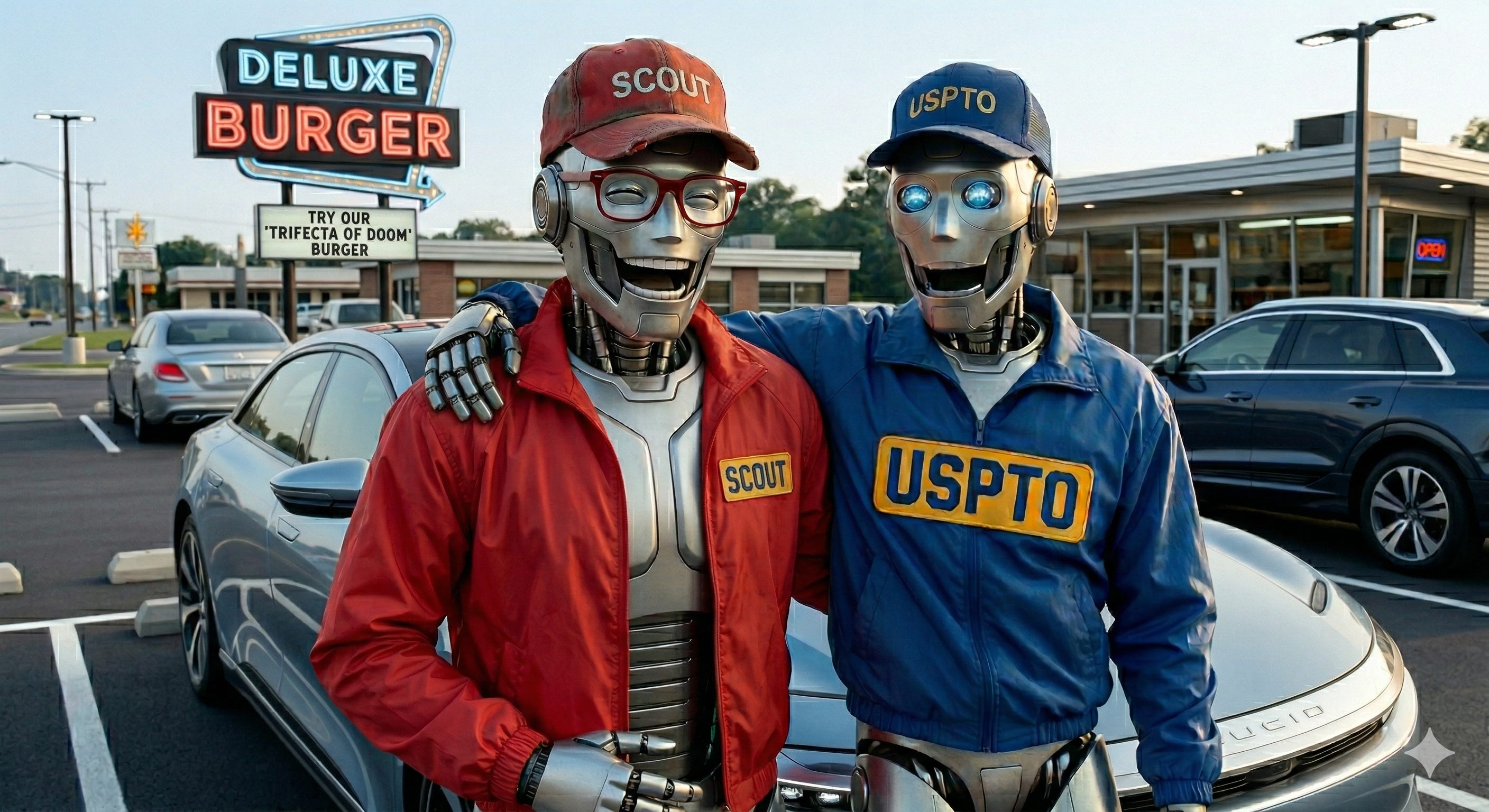
Legal professionals acknowledge an uncomfortable reality regarding subject matter eligibility: an absolute truth regarding any specific Alice analysis rarely exists. Subjectivity heavily influences the entire evaluation process.
Until the Supreme Court or Congress steps in, maybe AI tools can help.
The Alice Trifecta of Doom
Examiners frequently deploy a predictable rejection framework, often labeled the “Alice Trifecta of Doom.”
The sequence begins by boiling the patent claim down to a high-level abstract idea.
Next, the evaluator classifies the remaining claim limitations as purely functional.
Finally, the analysis dismisses any recited hardware as purely conventional.
A predictable set of patent drafting choices triggers this fatal sequence.
The rejection framework frequently activates when (A) a patent specification concedes the integration of “well-known” components or generic hardware (“any suitable”).
Written descriptions—especially pre-2014—that include (B) discussions regarding automating a manual process, or (C) excessive emphasis on concepts like “improving user experience,” also frequently invite this precise rejection pattern.

Once activated, recovering the claims requires a seemingly insurmountably high burden of including structural, highly specific, and/or super-narrowing language in the claim.
The Examiner Training Void
The examining corps faces severe operational constraints regarding modern jurisprudence. Interviews with examiners frequently reveal a specific operational deficit.
Examiners require dedicated training regarding the director’s Desjardins decision and MPEP update. Currently, many examiners rely heavily on seemingly outdated USPTO examples generated during prior Alice training initiatives.
Anecdotal reports indicate this reliance stems partly from frustration regarding the limited training hours allocated to the examining corps.
The lack of Squires-era instruction solidifies reliance on the Alice Trifecta of Doom.
A Proposed AI Approach
If the agency deploys a legitimate automated assistant, the system must enforce analytical balance.
Patent practitioners and the agency might evaluate the following structural prompt as a foundation for generating more neutral eligibility assessments.
You are an expert patent attorney specializing in patent subject matter eligibility under 35 U.S.C. § 101 and the Alice/Mayo framework. I will provide you with a patent text below.
Please analyze the subject matter eligibility of the first independent method claim according to the two-step Alice/Mayo framework. In your analysis, actively draw analogies to relevant Federal Circuit pro-eligibility case law (e.g., McRO, BASCOM, DDR Holdings, Contour IP, EcoFactor, Packet Intelligence, Visual Memory) where applicable.
Please structure your response exactly as follows, grounding each point in the specific language of the claims and relevant Federal Circuit precedent:
Step One Analysis (Is the claim directed to a patent-ineligible concept?)
Arguments FOR Eligibility (2-4 points): Explain why the claims are not directed to an abstract idea. Highlight aspects that suggest a specific, concrete technological advance or an improvement to a technological process/machine. Identify similar pro-eligibility cases where you can.
Arguments AGAINST Eligibility (2-4 points): Identify the underlying abstract idea and explain why the claim as a whole is primarily directed to this concept. Identify similar cases that were lacking eligibility if you can.
Step Two Analysis (Is there an inventive concept? - Conduct this step even if you argue for eligibility in Step 1)
Arguments FOR Eligibility (2-4 points): Explain how the claim elements, considered individually and as an ordered combination, amount to “significantly more” than the abstract idea by providing an inventive concept (e.g., unconventional steps, specific technical implementations). Compare claim elements to pro-eligibility cases.
Arguments AGAINST Eligibility (2-4 points): Explain why the additional elements are merely “well-understood, routine, and conventional” activity or generic computer implementation. Compare claim elements to cases that found ineligible claims.
Here is the patent:
[INSERT PATENT CLAIM(S) AND/OR SPEC HERE]
This structural prompt represents a solid starting point for Alice evaluators.
The prompt forces the automated system to construct arguments for eligibility, explicitly requiring the integration of pro-eligibility Federal Circuit case law.
Cases like McRO, BASCOM, and Contour IP provide a necessary counterweight to the high volume of invalidating court decisions.
Requiring a balanced output counteracts the default tendency of evaluators to generate immediate rejections.
Still, AI lies and the prompt is not perfect.

The Emergence of SCOUT
The agency recently accelerated internal testing of a generative artificial intelligence web application named “SCOUT,” an internal program structured for searching, consolidating, and outlining examination materials. Developed within a secure laboratory environment to protect unpublished application data, this platform provides examining staff with access to advanced language models calibrated for specific patent evaluation tasks.
Reports indicate current beta testing focuses on an antecedent verification feature to identify claim inconsistencies under Section 112 alongside a developer assistant for analyzing software code.
The application is anticipated to incorporate a specialized manual search feature, granting examiners immediate access to examination procedures. Agency employees suggest future iterations might assist in drafting the substantive content of office actions, moving the technology beyond basic prior art retrieval.
The structural capabilities of the SCOUT platform present a clear pathway for configuring the system to execute the precise subject matter eligibility analysis mocked in the recent press release.
The fictional “MATTHEW” system relies on celebrity absurdity. The underlying concept of an automated assistant evaluating claims under Section 101 aligns closely with the agency’s actual technological trajectory.
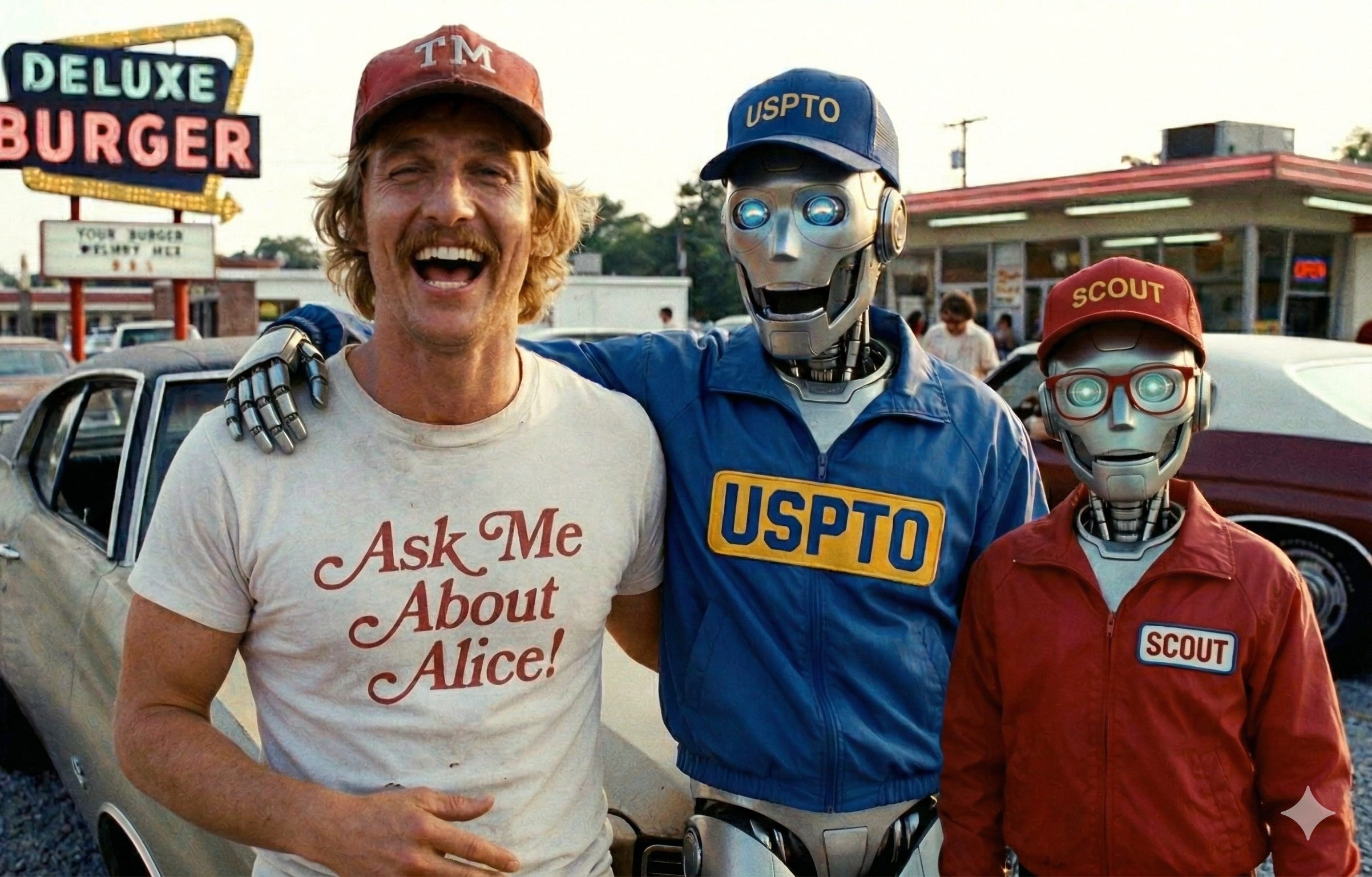
The parody rests uncomfortably close to operational reality, signaling that automated eligibility determinations remain a probable outcome of current testing. Patent practitioners must monitor this deployment closely, as the potential introduction of machine-generated reasoning into formal office actions creates new administrative hurdles for applicants rebutting automated conclusions.
Benefits, Challenges, and Risks
Implementing a balanced prompt structure offers distinct operational advantages. By forcing an automated system to actively search for technological improvements, this requirement disrupts the immediate default to the Trifecta of Doom.
The explicit inclusion of pro-eligibility precedent equips examiners with a broader perspective during prosecution, prompting a more thorough review of the technical specifications.
Developing such a system presents specific engineering hurdles. Instructing an algorithmic model to recognize the highly nuanced technological advances identified in cases like Enfish, BASCOM, or EcoFactor requires precise computational mapping of legal concepts. Without strict boundaries tied to accurate, verified legal databases, a language model might invent case analogies or misinterpret court holdings.
Information security introduces an additional technical obstacle. Any system deployed by the USPTO must operate within a secure sandbox environment to maintain the strict confidentiality of yet-to-be-published patent applications.
Initial testing and calibration of these language models should exclusively utilize public, non-confidential materials to prevent the inadvertent disclosure of sensitive commercial assets.
The primary risk involves an over-reliance on automated outputs. If examiners adopt generated arguments without independent verification, the examination process risks automating and scaling existing biases.
A poorly calibrated system might generate rejections that appear plausible on the surface but lack sound legal reasoning. Such a scenario forces patent applicants to expend significant financial resources rebutting machine-generated logic. Algorithmic tools do not substitute for rigorous human analysis.
The current examination environment, however, presents a difficult irony.
Receiving a boilerplate rejection using the Trifecta of Doom frequently leaves practitioners questioning whether genuine human analysis is presently occurring during manual examination.
Conclusion
The agency’s April Fools parody succeeded by mocking a deeply fractured system. The intellectual property community requires substantive, predictable reform regarding subject matter eligibility. Until structural changes materialize, deploying supervised algorithmic assistants using carefully balanced prompts represents a pragmatic operational strategy.
Developing an autonomous artificial intelligence agent operating without human oversight appears unnecessary. Standard large language models possess extensive familiarity with federal case law published prior to their initial training dates. Supplying these models with specific legal texts, or employing fine-tuned systems trained exclusively on patent jurisprudence, improves analytical accuracy.
The examining corps requires tools that present multiple legal arguments. Examiners must evaluate those arguments and select the most applicable reasoning, relying entirely upon their specialized training and professional experience. This supervised framework likely represents the near-term future of automated assistance at the USPTO and parallel federal agencies. A structured approach protects software and diagnostic innovations from arbitrary administrative evaluation.
Disclaimer: the ideas are solely for experimental use in exploring legal and patent analysis. Such guides, code, prompts, and/or any results are not intended to replace the critical judgment of a qualified professional. It is your responsibility to thoroughly verify all outputs and information as AI models are prone to errors and hallucination. Do not bill clients for time/work performed by AI and/or software tools. Follow all rules in accordance with your state bar and/or ethics and governing body.
This is provided for informational purposes only and does not constitute legal or financial advice. To the extent there are any opinions in this article, they are the author’s alone and do not represent the beliefs of his firm or clients. The strategies expressed are purely speculation based on publicly available information. The information expressed is subject to change at any time and should be checked for completeness, accuracy and current applicability. For advice, consult a suitably licensed attorney and/or patent professional.